• Skip to primary navigation
  • Skip to main content
  • Skip to primary sidebar
  • Skip to footer

ForexSchoolOnline.com

Learn to Trade Forex Online

  • Compare Brokers
    • Broker Type
      • Paypal Brokers
      • Swap-Free Brokers
      • Low Spread Brokers
      • ECN / STP Brokers
      • Market Maker Brokers
      • Non Dealing Desk Brokers
      • Low Minimum Deposit Brokers
    • Country
      • Brokers for Australia
      • Brokers for South Africa
      • Brokers for the UK
      • Brokers for the US
      • Brokers for Nigeria
    • Regulation
      • FCA Regulated Brokers
      • ASIC Regulated Brokers
      • FSCA Regulated Brokers
      • CFTC Regulated Brokers
    • Platform
      • MT4 Brokers
      • MT5 Forex Brokers
    • Strategies
      • Hedging Forex Brokers
      • Scalping Forex Brokers
      • Carry Trade Forex Brokers
      • Brokers for Indicators and EA’s
  • Start Here
    • Start Trading Guide
    • Beginner Trading Lessons
  • Free Forex Course
    • Public Login
    • Register
    • Password recovery
  • Lessons
    • Strategies
    • Videos
    • MT4 Guides
    • Money Management
  • Trade Setups
  • Tools
    • Correct Free Demo Charts
    • Forex Journal Download
    • Position Size Calculator
    • FULL List of Tools
    • Forex Demo Accounts
  • Price Action Guide
  • Free Course

What is Forex Rollover? Credits and Debits Explained

Forex rollover is the amount of interest that you will either be credited or debited if you are still holding an open trade at the end of the trading day.

Whether you are credited or debited will depend on the Forex pair you are holding. You do not pay or receive any rollover interest unless you are holding an open position at the day’s end.

Rollover payment amounts are calculated by using the interest rates from the two currencies in the pair you are trading.

Your trading position will earn you a credit if the currency’s long interest rate is higher than the currencies short interest rate.

NOTE: Below I show you how to find these rates in live time.

On the other hand, your position will pay a debit if the currency’s long interest rate is lower than the currencies short interest rate.

Each broker will have a different time for the day’s end, so please check with your broker for the correct interest rates and also for their close of day time.

You can find more information on rollover and swap rates from this informational article on Pepperstone website HERE.

You can also find up-to-date rollover rates inside your MT4 terminal.


How to Find Rollover Rates on MT4

To find up-to-date rollover rates, open your MT4 terminal.

– Select the ‘Market Watch’ window and then right click anywhere inside the market watch panel.

– From the options select ‘Symbols’

– When a new window appears find the Forex pair you are interested in.

– Select ‘Properties’ and you will be presented with details regarding that Forex pair including your swap rates for both long and short trades.

See image below on how you can do this;

forex swap and follover


Lastly, keep in mind each broker will rollover at different times and also have different swap rates.
 

How do Forex Brokers Make Money?

Brokers make money in one of two ways.

The first way is adding spreads and commissions onto your trade to make a profit.

The other way a broker makes a profit is to ‘make a market’ and profit from you losing. In other words; the market maker broker takes the other side of your position and profits from your loss.


Difference Between Market Maker, ECN / STP Brokers

ECN and STP brokers make money when they charge you either a commission or the spread for each trade you place.

They are taking your trade and it is being automatically processed through to their liquidity providers such as banks.

The group of banks sends back a price, the broker adds a spread onto the price they offer to you and the broker profits from the spread they charge to you as the trader.


The No Dealing Desk model has three types of brokers:

  1. STP – Straight-Through Processing
  2. ECN- Electronic Communication Network
  3. DMA – Direct Market Access


Most retail traders prefer to trade with the ECN (Electronic Communication Network) model broker.

The ECN model of trading technology allows traders to quickly and efficiently enter orders against others in the markets who are sending in competing bids and offers. The system then sorts the orders and your trade is completed with transparency.


Market Makers

The market maker broker is not operating in the same way as an ECN / STP broker.

The market maker is taking your order as the trader and trying to match it with their book of orders. The market maker is making the market and creating the quotes you are given. They are able to see your targets and also your stop loss.

The market maker is the counterparty to your trade. If you win, they lose. If you lose, they win. There is a conflict of interest.

If you choose to go down the market maker broker path, then do a lot of research to ensure you are trading with an incredibly reputable broker.


What Broker Model Should You Choose?

It is up to each individual trader which broker they go with, but there are some incredibly crucial factors that you need to consider when choosing a broker.

There are also some basic standards that your broker should meet and these are discussed in the trading lesson; Recommended Forex Broker & Charts which goes through exactly what your broker should provide.


What’s Better? Dealing Desk vs No Dealing Desk Forex Brokers

Before you choose a broker it’s important to understand and learn that not all brokers are the same.

There are different types of Forex brokers that run their business through different trading models.

When you trade in the Forex market you need to know who you are trading against and exactly where you order is going for execution as this will give you a solid understanding of how the Forex market works.


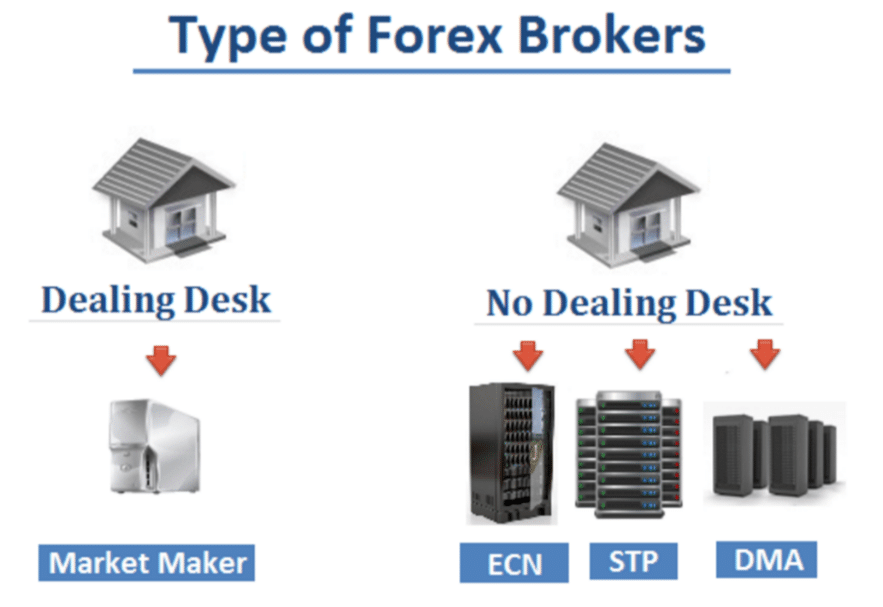
There are two different types of Forex Brokers:

  1. Dealing Desk Brokers;
  2. No-Dealing Desk Brokers;

types of brokers


Dealing Desk Forex Broker

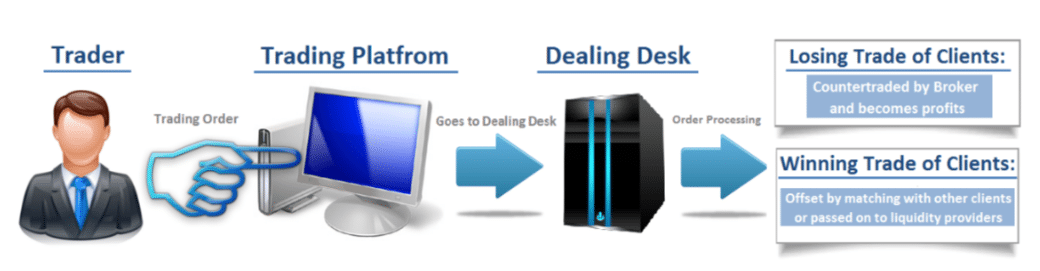
A Dealing Desk broker is also called a market maker because they make the market for their clients providing them with the liquidity to execute their trades.

In this execution model when you trade profitably you make money off the dealing desk broker.

On the other hand, your broker profits from your trading losses. This also means that you trade against your broker and your order is not being sent to the real inter-bank market.

Since the Dealing Desk broker keeps your order in-house and does not execute it to the real market, it’s no wonder that Dealing Desk brokers have a conflict of interest against their clients.

In the figure below you have a representation of how a typical trade works using a Dealing Desk Broker:

dealing desk broker


No Dealing Desk Forex Broker

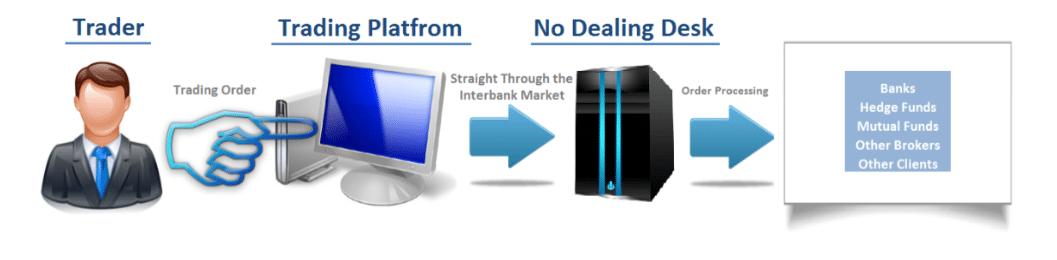
No Dealing Desk brokers provide immediate access to the interbank market.

Essentially the No Dealing Desk model comes from the fact that there is no human intervention when a client places a trade so everything is executed automatically.

The prices you see at your trading platform are live quotes from global banks which means that the price you have when you click is the final price for your position.

no dealing desk broker


From a trader’s point of view there’s a number of advantages:

– Transparency

– No re-quotes

– An alignment of broker and trader interests

– Fast execution

– Deep liquidity


In the No Dealing Desk model there are three types of brokers:

  1. STP (Straight-Through Processing)
  2. ECN (Electronic Communication Network)
  3. DMA (Direct Market Access)


Usually, the ECN broker (acronym that stands for Electronic Communication Network), are the preferred broker style among retail traders.

The ECN model is an electronic trading technology where all market participants trade against each other by sending competing bids and offers into the system.

This allows your orders to interact with other trader’s orders with a great transparency.


Lastly

Whilst there are pros and cons to both types of brokers, there are some crucial standards that all brokers should meet. You can read about what to look for in a Forex broker at Recommended Forex Brokers and Charts.


« Previous Page
Next Page »

Primary Sidebar

Forex School Online

High Probability Price Action Trading

How to make, manage and take profit from trades in the markets

Start Learning (It's Free!)

Turn Your Trades into Winners!

The Price action course is the in-depth advanced training on assessing, making and managing high probability price action trades.

Sign up for Free!

Recommended Broker

  • Broker
  • Min Deposit
  • Benefits
  • Score
  • Visit Broker

$200

T&Cs Apply
  • The Lowest Trading Costs
  • 50% Welcome Bonus
  • Award-winning 24 Hour Support
5
Trade Now FreeBets Reviews
Reviews

Footer

Get Our FREE Course, Bonus Strategies & Indicators!
X
Join Us Now!

Your capital is at risk.

X

CORNERSTONE LESSONS

Forex Trading for Beginners

Price Action Trading

How to Trade Forex

Technical Analysis

Forex Charts

Forex Trading Strategies

Money Management 

Compare Brokers

Best Forex Brokers

Forex Demo Accounts

Best Forex Trading Platforms

Forex Apps

Swap Fee Accounts

MT4 Brokers

CATEGORIES

Forex Videos

Trading Lessons

Weekly Trade Ideas

Start Here Guide

ForexSchoolOnline.com helps individual traders learn how to trade the Forex market

WARNING: The content on this site should not be considered investment advice and we are not authorised to provide investment advice. Nothing on this website is an endorsement or recommendation of a particular trading strategy or investment decision. The information on this website is general in nature so you must consider the information in light of your objectives, financial situation and needs.

Investing is speculative. When investing your capital is at risk. This site is not intended for use in jurisdictions in which the trading or investments described are prohibited and should only be used by such persons and in such ways as are legally permitted. Your investment may not qualify for investor protection in your country or state of residence, so please conduct your own due diligence or obtain advice where necessary. This website is free for you to use but we may receive a commission from the companies we feature on this site.

We Introduce people to the world of currency trading. and provide educational content to help them learn how to become profitable traders. we're also a community of traders that support each other on our daily trading journey

Forexschoolonline.com is not a financial advisor. Do your research before investing your funds in any financial asset or presented product or event. We are not responsible for your investing results.

Copyright © Forex School Online Sitemap  - Privacy Policy - Disclaimers & Terms of Use - CONTACT US