• Skip to primary navigation
  • Skip to main content
  • Skip to primary sidebar
  • Skip to footer

ForexSchoolOnline.com

Learn to Trade Forex Online

  • Compare Brokers
    • Broker Type
      • Paypal Brokers
      • Swap-Free Brokers
      • Low Spread Brokers
      • ECN / STP Brokers
      • Market Maker Brokers
      • Non Dealing Desk Brokers
      • Low Minimum Deposit Brokers
    • Country
      • Brokers for Australia
      • Brokers for South Africa
      • Brokers for the UK
      • Brokers for the US
      • Brokers for Nigeria
    • Regulation
      • FCA Regulated Brokers
      • ASIC Regulated Brokers
      • FSCA Regulated Brokers
      • CFTC Regulated Brokers
    • Platform
      • MT4 Brokers
      • MT5 Forex Brokers
    • Strategies
      • Hedging Forex Brokers
      • Scalping Forex Brokers
      • Carry Trade Forex Brokers
      • Brokers for Indicators and EA’s
  • Start Here
    • Start Trading Guide
    • Beginner Trading Lessons
  • Free Forex Course
    • Public Login
    • Register
    • Password recovery
  • Lessons
    • Strategies
    • Videos
    • MT4 Guides
    • Money Management
  • Trade Setups
  • Tools
    • Correct Free Demo Charts
    • Forex Journal Download
    • Position Size Calculator
    • FULL List of Tools
    • Forex Demo Accounts
  • Price Action Guide
  • Free Course

Forex Market Size, Volume And Liquidity

The Forex market is by far the biggest market in the world averaging a turnover of $5.1 trillion dollars a day.

Because of the giant size of the market, it is a great market for traders who want to make swing trades, scalp trades and day trade.

You can enter the markets without delay, with very tight spreads, and good leverage.

This lesson looks at exactly how big the Forex market is, who exactly is making trades, and the countries that are trading Forex the most.


How Big is the Forex Market?

In 2016 the Bank for International Settlements (BIS) released their three yearly report.

This is a wide scoping report and we will use some of these figures for today’s lesson.

In 2013 there was on average $5.4 trillion dollars per day being traded and in 2016 there was $5.1 trillion dollars being averaged.

What is most interesting about these statistics is that there are a few global powerhouses that account for the bulk of these figures.

The major currencies also account for by far the bulk of trades being made.


Who are the Biggest FX Players?

In the last Bank for International Settlements report the amounts that are being traded are divided into segments; 

– Institutional traders: these are the large banks, governments, hedge funds and other portfolio managers.

– Retail traders: these are the individual traders, home traders and other professional traders not running large organisations.


In the market we have large organisations, banks and investment banks on one side, and on the other side we have the retail traders speculating on the markets and trying to make profits.

What may or may not surprise you, is that institutional trading makes up 90% of the Forex market cap. Only 10% of trades are being carried out by individual retail traders.

These figures are pretty important to understand. It is clear why the ‘big money’ moves the markets. No matter how large a retail trader is, they are not moving markets.

As a retail trader you also have a lot different trading conditions with your broker to that of an institution. 

Thinking about these numbers when you are next identifying and managing trades will open your eyes to what is really happening.

When you see that next false break of a key support or resistance, or when price moves ‘close’, but not quite to a major supply or demand level you will look at it differently.


Forex Market Liquidity and Volume

With the Forex market available to trade 24 / 5, having a large amount of liquidity is incredibly important.

With large volumes of orders being placed creates a steady flow of high liquidity.

This allows you to enter and exit your trades with ease and speed.

Whilst in some markets you may be trapped and waiting for a buyer to enter, in the Forex market there is such an incredible amount of volume you will not have to wait to execute your trade.

The most heavily traded currency pairs in the world are the EURUSD and USDJPY. These two pairs alone account for 41% of all trades placed in the Forex market.

Another astounding statistic is that the US Dollar makes up 85% of all trading volume. The Euro comes in second, followed by the Japanese Yen.


What Countries Trade the Most Forex?

The last Bank for International Settlements report showed that the top three countries with the largest volume being traded in the Forex market are the United Kingdom, United States and Singapore.

See the graph below highlighting just how lopsided this is;
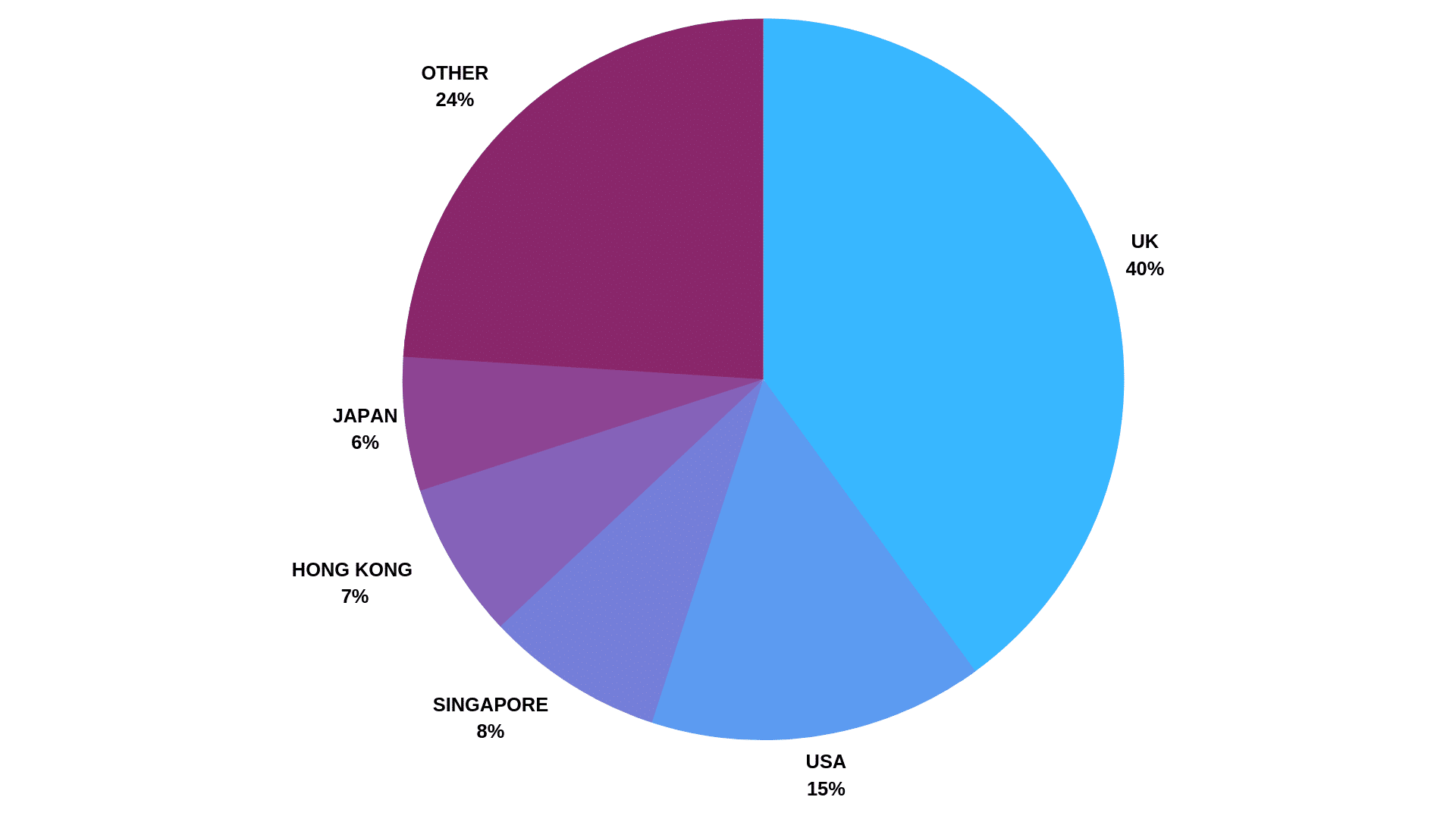
COUNTRIES TRADING MOST FOREX

Because these three countries have such large volumes, it is a major reason why the markets look to each of their trading sessions; Asian, London and New York Sessions.

You will note that the largest amount of trading is carried out when the two big players are having their trading sessions overlap. When the London and New York trading sessions are trading at the same time a large proportion of the days volume is processed.


What are the Most Heavily Traded Currency Pairs?

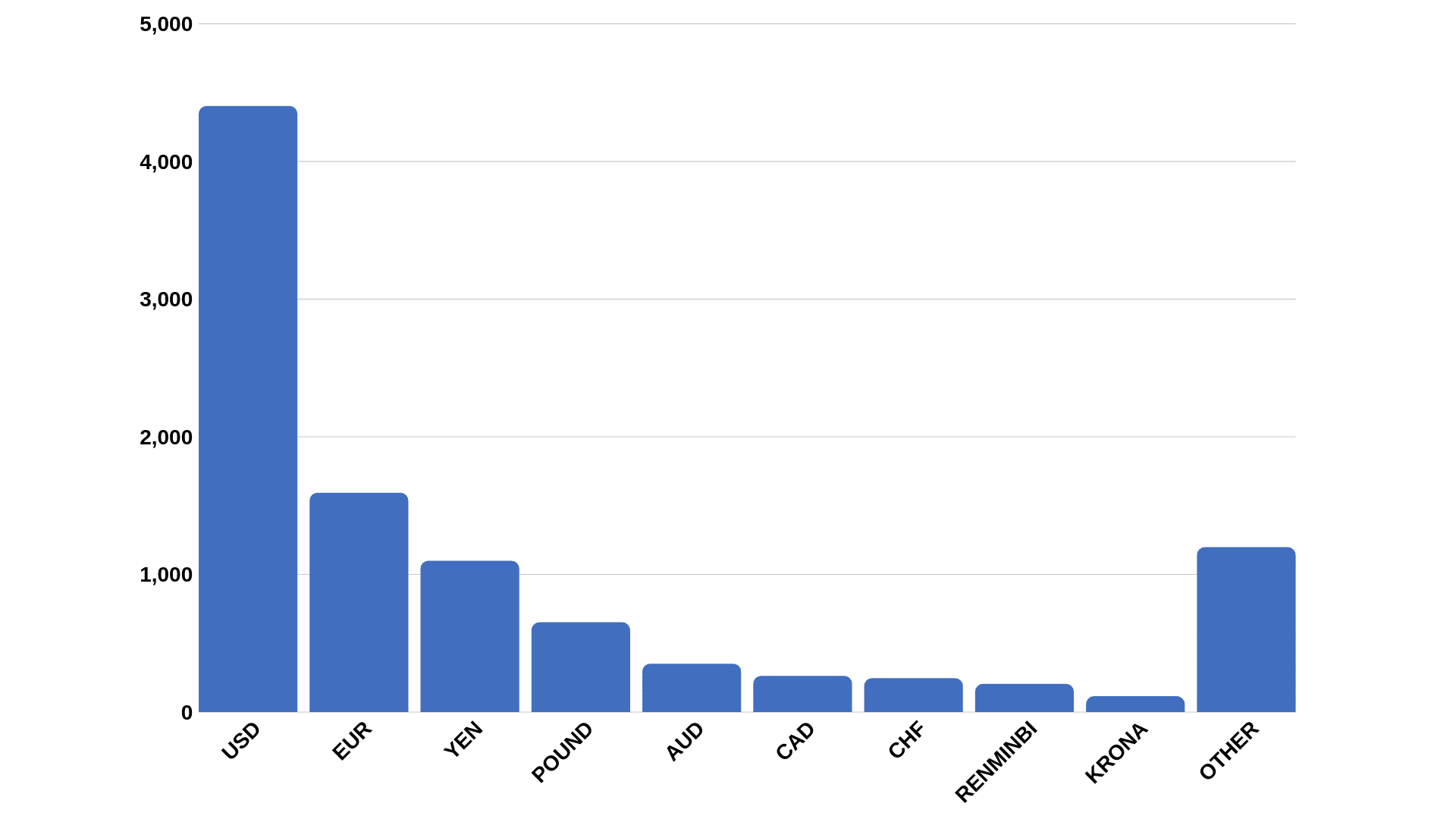
Below I have listed in order the most traded currencies in the world.

  1. US Dollar
  2. Euro
  3. Japanese Yen
  4. British Pound
  5. Australian Dollar
  6. Swiss Franc
  7. Canadian Dollar
  8. Renminbi (Chinese Yuan)
  9. Swedisk Krona
  10. Other currencies.


Forex Market Size, Volume And Liquidity


What’s interesting to note is that the Chinese Yuan (Renminbi) has been steadily climbing and is now sitting in 8th place of most traded currencies.


Recap

The Forex market is the biggest market in the world by far.

Whilst it might be the biggest, the bulk of the trading is carried out by a handful of countries and on only a few major currencies.

 

The History of Forex Trading

Forex trading as we know it today has been shaped and created by some large global events.

Trading and exchanging currencies is often said to date back to Babylonian times. 

The Forex market we trade today is the biggest in the world averaging $5.1 trillion dollars turnover each day and is the most accessible market for retail traders in the world.

Why should you even care about the history of Forex trading, key events and how the markets have been shaped?

If we don’t learn from the past, we are bound to repeat our mistakes. Learning how the currency markets were created and the major events that led to the markets being what they are today will help us spot similar events coming on the horizon.


Where Forex Trading All Began

Barter systems have been used for thousands of years. This is the first method of ‘Foreign exchange’.

Under the barter system tribes could exchange their goods for other goods they needed.

It is said that this method of exchange dates back to 6000 BC and was introduced by the Mesopotamia tribes.

Eventually the first Gold coins were created as early as 6 BC. Gold coins were used because they were widely accepted, were durable and there was a limited supply.

Whilst Gold coins were widely accepted, they were also very heavy and this made them impractical.

In the 1800s the Gold standard was created which meant the government would redeem the equivalent amount of paper money for Gold.

This system worked well until the First World War started and countries in Europe had to print more money to pay for the war. 


Major Events in the History of Forex

There have been a lot of major historical events that have shaped the Foreign exchange markets and how we know them today.

Below I run through a few of the major events;


1944 – 1971: The Bretton Woods Agreement

As World War II was nearing its end, the United States, France and Great Britain met at the United Nations Monetary and Financial Conference in Bretton Woods.

The goal for the meeting was to create a new economic global order. 

BRETTON WOODS

At the time of the meeting a lot of the European countries had suffered greatly from the war and the US currency was being seen as more stable.

The new agreement; the Bretton Woods Accord was created so that a new and stable environment could be created for countries to restore their economies. 

At the time of the accord the US dollar was being pegged to Gold. The Bretton Woods accord set out to create an adjustable pegged currency market.

This meant that countries could peg their currency to the US dollar that itself was pegged to Gold.

This agreement eventually failed due to increased government spending and lending meaning there was not enough Gold to peg to the US dollar.

President Nixon ended the Bretton Woods agreement in 1971 that led to a new currency exchange system.


1971: Creating the Free Floating Currency System

The next agreement that was struck was the Smithsonian agreement in 1971.

The United States depreciated their dollar by pegging it to gold at $38 / ounce. This new agreement was quite similar to the Bretton Woods agreement, but now currencies had a larger amount they could fluctuate.

Whilst the US dollar was pegged to gold, other major Foreign currencies could now move by 2.25% against the USD.

In 1972 France, Belgium, Luxembourg, Italy, the Netherlands and West Germany tried to move away from being stuck with the US dollar. The European Joint agreement was created, but not long after it failed.


1985: The Plaza Accord

In 1985 a meeting between the five top economies of the world (G-5) – US, Great Britain, West Germany, France and Japan took place at the Plaza Hotel in New York City.

Whilst this meeting was meant to be a secret gathering, word soon spread about the meet up forcing the G-5 to release a statement. The statement encouraged the appreciation of currencies that were non-dollar currencies.

This meeting soon became known as the Plaza Accord and soon after there was a sudden fall in the US Dollar.

Not long after these spikes in currency price, traders twigged on to the large potential profits from trading currencies.

Because of the new found fluctuations in price, there was a new market being created for traders to profit from.


1992: Creation of the Euro

At the end of World War II Europe was attempting to bring stability to the region and build their economies.

This led to many agreements and treaties being created such as the Maastricht Treaty.

The Maastricht Treaty was important because it established the European Union (EU) and this in turn then led to the creation of the Euro as a currency.

New policy and initiatives were created to bolster foreign affairs and security. These gave businesses, banks and other important organisations security and took away a lot of the currency exchange risk.


1990s – 2000s: Trading Forex on the Internet

With the internet improving, the world becoming ever closer together and the currency markets becoming more sophisticated, the 1990s saw the Forex markets grow rapidly.

Whereas previously the currency markets were available to large banks and institutions, all of a sudden a retail trader could speculate and make trades from their home.

Currencies traded ammount

This changed the markets and how they operate forever.

In the 2000s the communication equipment and internet speeds greatly increased that led to an even further opening of the Forex markets to new traders.

Whilst more and more people were finding the Forex markets, more opportunities and tools were being created to service the market.

Forex brokers became far more advanced with far quicker trade execution times, more Forex pairs became available to trade and trading costs were slashed. 


The Future of Forex Trading

The Foreign Exchange market that we know today is the largest market by far in the world.

Whilst the stock market does on average $200 billion dollars per day, the Forex market turns over $5.1 trillion dollars.

One thing about the future of the Forex market is sure; it will change.

The world and its economies are becoming closer by the day. How this affects the Forex market only time will tell.


Stop Loss Order: How to Use in Your Forex Trading (With Examples)

A stop loss order is an order you should be using on every single trade to protect your trading capital if price moves against your position.

Whilst we all want to make winners 100% of the time, this is simply impossible, and having a smart stop loss strategy ensures that we can minimize the times when we don’t get the trade right, so our winners make us profits.

An example of this may be; you buy the EURUSD at 1.3150 and have a profit target of 1.3250.

You may set your stop loss at 1.3100 so that if price goes against you, you are stopped out and the trade is closed, but if the trade goes in your favor you could make twice what you are risking.

The 3 major reasons you should be using a stop every single trade are;

– Preserve your trading account and always live to trade another day.

– Money management: minimize your losses so you can maximise your gains.

– Prevent one trade blowing your whole account or putting a major dent in it.


A stop loss is a complete waste of time if you continue to move it and you don’t actually let the market take you out for a small loss.

Before placing your stop loss, make sure you accept the risk of the trade you are about to place and where you could be stopped.

Be prepared to take a small loss on the chin so that when you make winning trades they can actually make you profits.

If you need to read about the different types of orders you can use, then checkout;

– Buy Limit and Buy Stop Order Explained With Examples

– Sell Limit and Sell Stop Order Explained With Examples


3 x Stop Loss Strategy Examples

With all stop loss strategies there are a few keys to remember that will really help;


Find and Read The Market Story and Structure

Every market has a price action story and structure.

Knowing if there is a trend, range, the recent momentum, swing highs and price action will help you when it comes to placing your stop loss.


Use the Price Action Trend and Story in Your Favor

You can use different stop strategies in different markets.

You can be more aggressive in some markets compared to others. This is the case when the market is strongly and obviously trending in one direction.


Take as Much Time With Your Stop Loss Placement as You do Your Entry

Don’t just ‘plonk’ your stop loss on where you always have and with little thought.

I bet you take great care to find your entries. Your stop loss could decide if you stay in the trade and if you do, how much money you end up making.


Major Swing and Support / Resistance Areas

This is a popular method of setting stops especially for swing traders who are looking to make profits from the larger swings in the market.

The good thing about this strategy is that it can be a solid method for not only setting your stop loss, but also for re-setting and trailing your stop loss as price moves in your favor.

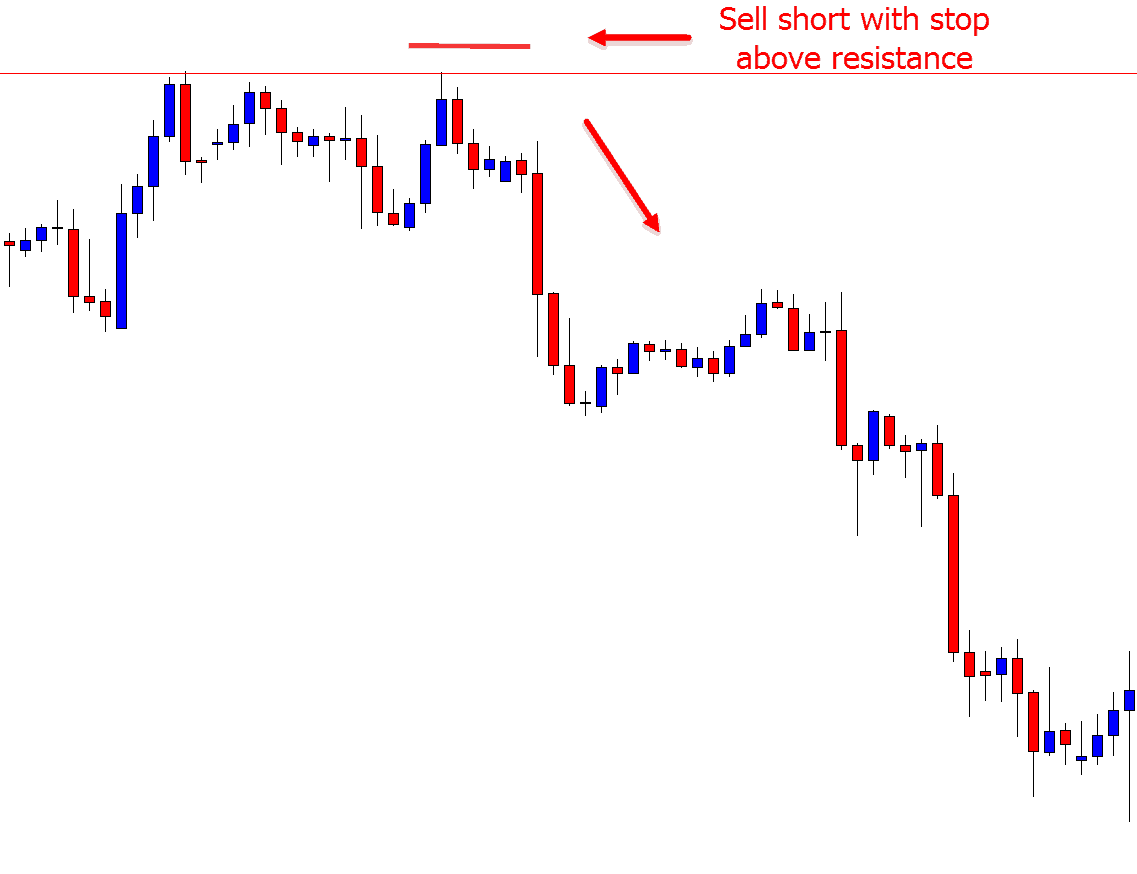
When setting your stops using the major support and resistance areas you are using the major areas or supply and demand and support / resistance.

See a chart example below;

swing resistance stop loss


You MUST take a few things into consideration;

– Look at the overall price action story. This includes the market type and recent momentum.

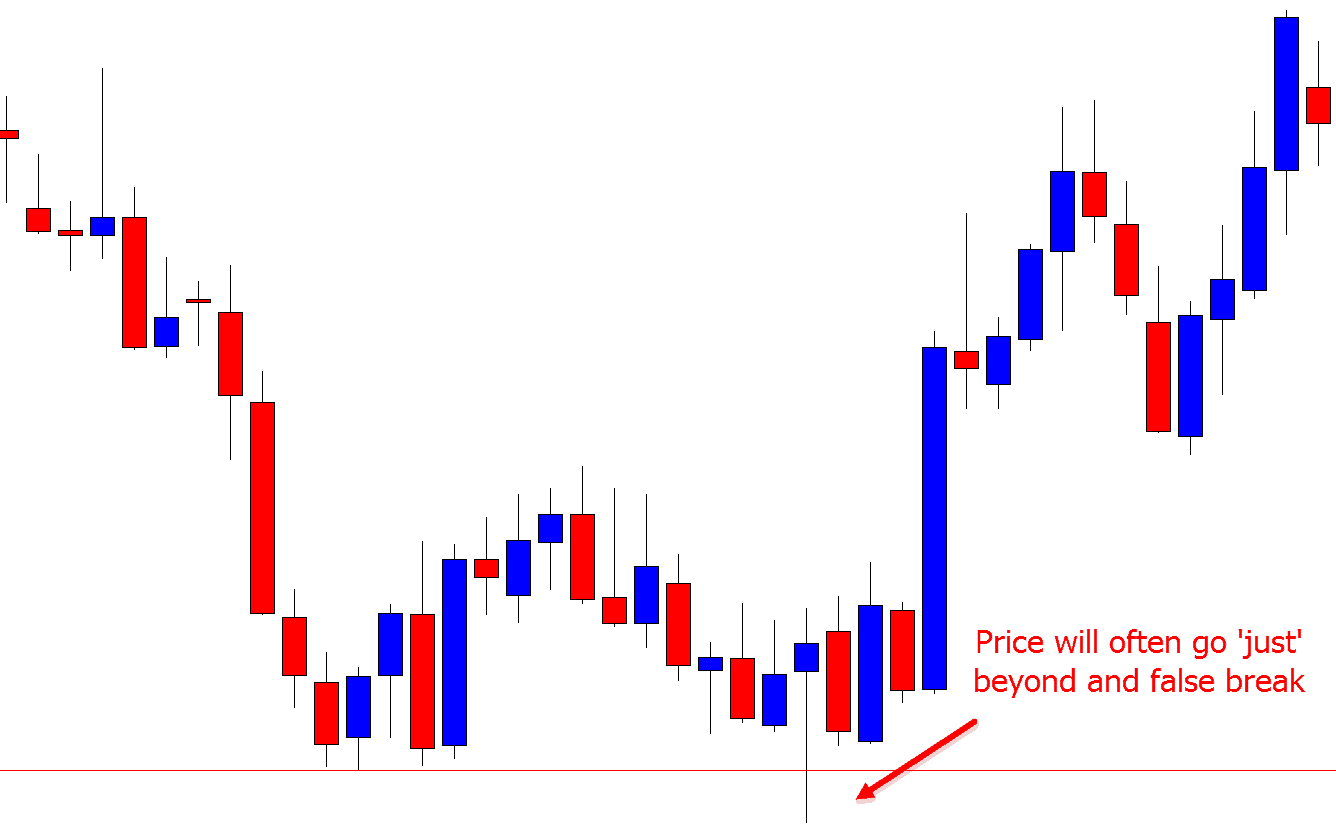
– Price will often go just above or below a certain level and then reverse.

– Set your stop wisely where price is the highest chance of remaining in the trade and not being faked out.


I am sure you would have noticed that price will often move just above or below a major support or resistance level, creating a false break and then reversing. You must take this into account if using this method.

See the chart below; the big players understand this and will move the market just beyond a level, before creating a false break.


false break stop loss


Trailing Stops

To trail your stop loss means you are continually moving your stop loss higher or lower to lock in profits.

If price was to swing against you, then you would be taken out with profits locked in.

You can choose to trail your stop loss either right from the start of your trade, or only once price has reached a certain point and you want to begin locking in profits.

An example of this may be that you want to wait for price to move to a certain target level and then look to lock in profits by moving your stop higher or lower.

The pros of trailing your stop loss are that you are continually locking in profits whilst also still giving your trade a chance to make further profits.

The cons are that you are moving your stop continually closer to the current price and risking having your position exited prematurely.

There are many different strategies to trail your stop loss including the two other strategies we discuss in this lesson; using price action and major swing highs and lows.

Another popular strategy is moving your stop loss above or below a certain number of candles. For example; price moves higher into profit by 100 pips and you now begin trailing your stop below the low of the 4th last candle. 

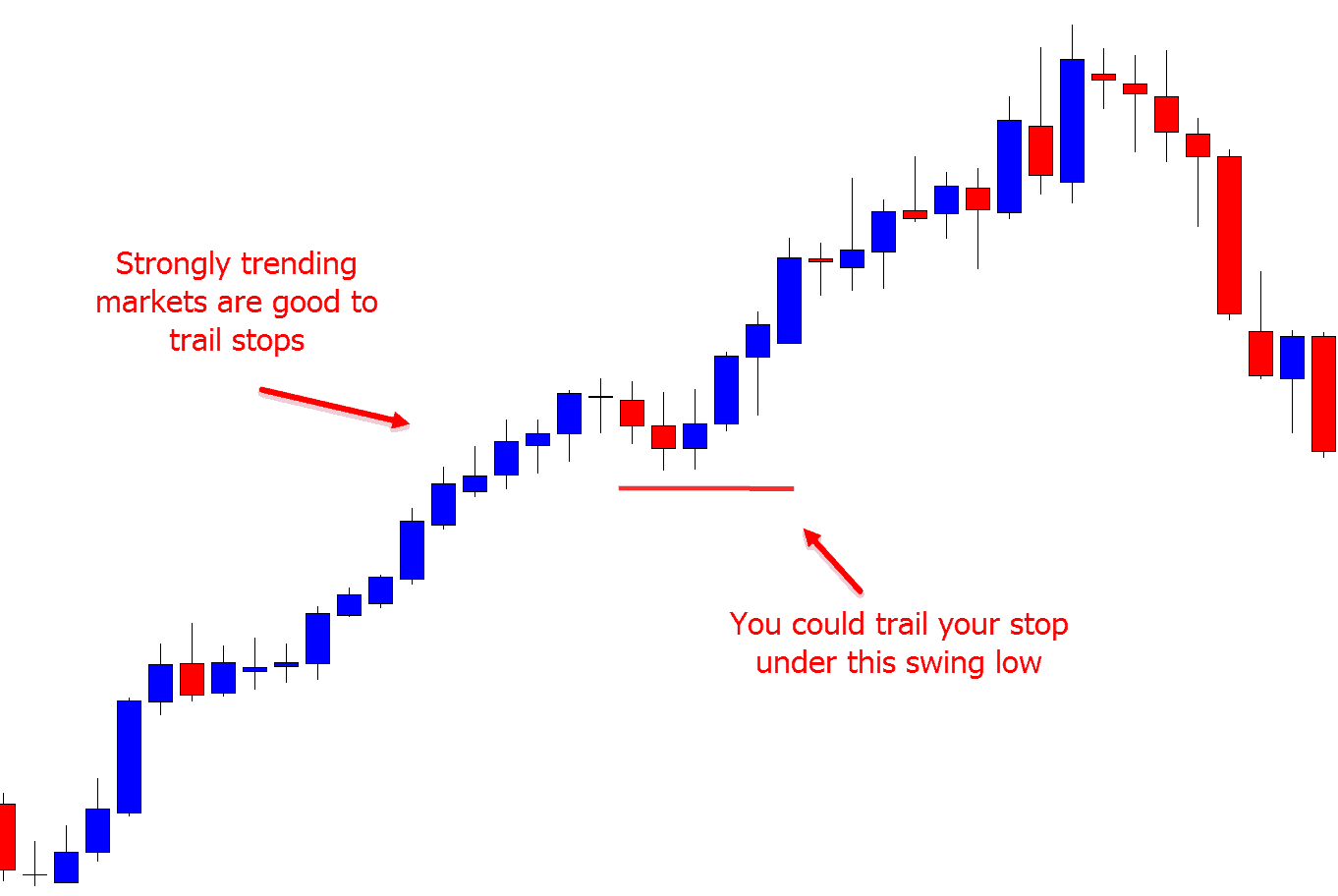
Something to consider when thinking about trailing your stop is that it will work by far the best in a strongly trending market.

This is the case because you are continually moving your stop in behind price higher or lower. If price is in a ranging or sideways market you are far more likely to be taken out early. In a trending market you have a higher likelihood or trailing your stop with a larger move.

trail stop strong trends


Reading Price Action to Set Your Stop Loss

This stop loss strategy includes methods such as;

– Using the candle high or low for your stop. For example; a pin bar high or low.

– Using the surrounding price action story.

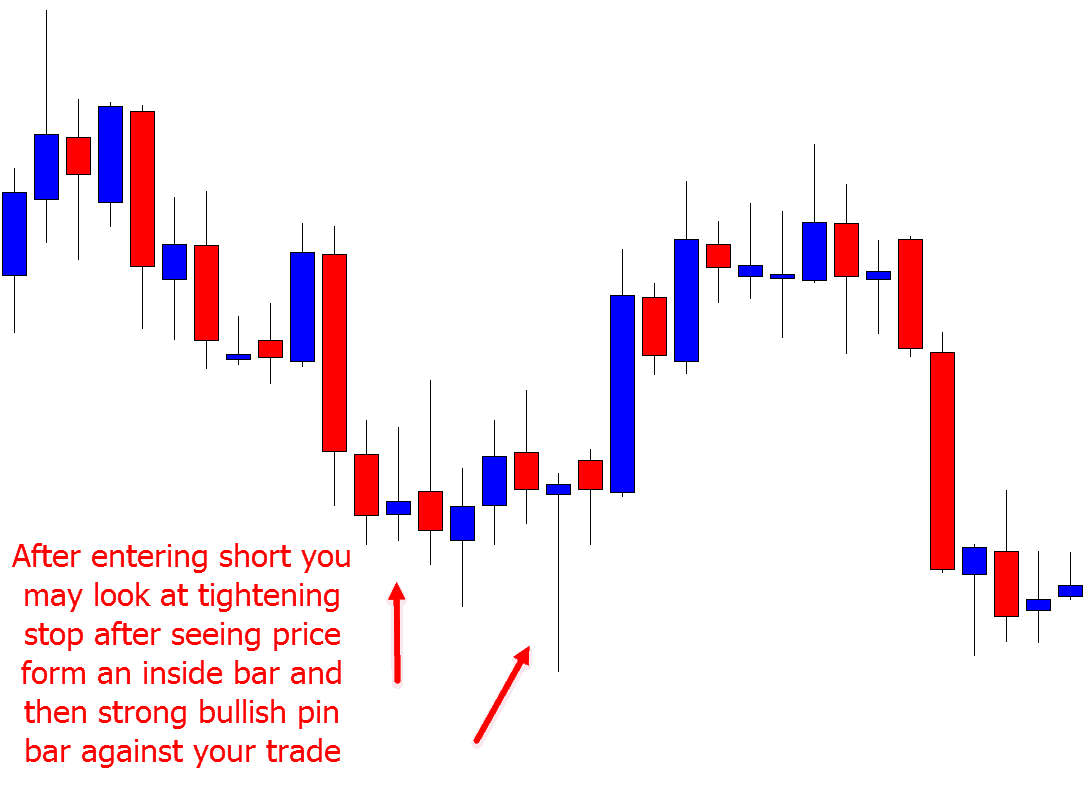
– Reading other price action. For example; you may use the high or low of a recent inside bar that is at an important level.


This method to set your stop loss is the most advanced strategy discussed in this lesson because of all the strategies it requires a strong understanding of how to use the price action story.

When using recent swing highs or lows or using a trail you are using the same strategy for each stop loss. When using price action to read and also move your stop you are using what is actively happening in the markets, making it far more challenging.

I have attached a chart below showing how you might use price action to set your stop loss.

price action stop

This method of setting stops is not recommended for new traders, but it could be used by advanced traders to find tighter stops and also help them trail to lock in profits.

I have found one of the best strategies for new traders to set their take profit and stop loss orders is to learn how to set and forget their trading.


Lastly

There are a lot of other stop loss strategies that are not discussed in this lesson.

Another popular strategy is using the break even stop which can be incredibly effective when used correctly, but would need a lesson of its own.

Make sure you take the same time and care with your stop loss that you do with finding your entries.

Your stop will help you get better risk reward and also could determine a winning or losing trade.

Don’t just plonk it on at the same place because that is what you have always done.

Make sure you practice any new stop method on a risk free demo account before risking any real money so that when it comes time to trade with real cash you have full confidence in what you are doing and carrying out the trade.

Practice finding where you can get the best returns for the smallest risk with your stop strategy. It could make a very large difference.


« Previous Page
Next Page »

Primary Sidebar

Forex School Online

High Probability Price Action Trading

How to make, manage and take profit from trades in the markets

Start Learning (It's Free!)

Turn Your Trades into Winners!

The Price action course is the in-depth advanced training on assessing, making and managing high probability price action trades.

Sign up for Free!

Recommended Broker

  • Broker
  • Min Deposit
  • Benefits
  • Score
  • Visit Broker

$200

T&Cs Apply
  • The Lowest Trading Costs
  • 50% Welcome Bonus
  • Award-winning 24 Hour Support
5
Trade Now FreeBets Reviews
Reviews

Footer

Get Our FREE Course, Bonus Strategies & Indicators!
X
Join Us Now!

Your capital is at risk.

X

CORNERSTONE LESSONS

Forex Trading for Beginners

Price Action Trading

How to Trade Forex

Technical Analysis

Forex Charts

Forex Trading Strategies

Money Management 

Compare Brokers

Best Forex Brokers

Forex Demo Accounts

Best Forex Trading Platforms

Forex Apps

Swap Fee Accounts

MT4 Brokers

CATEGORIES

Forex Videos

Trading Lessons

Weekly Trade Ideas

Start Here Guide

ForexSchoolOnline.com helps individual traders learn how to trade the Forex market

WARNING: The content on this site should not be considered investment advice and we are not authorised to provide investment advice. Nothing on this website is an endorsement or recommendation of a particular trading strategy or investment decision. The information on this website is general in nature so you must consider the information in light of your objectives, financial situation and needs.

Investing is speculative. When investing your capital is at risk. This site is not intended for use in jurisdictions in which the trading or investments described are prohibited and should only be used by such persons and in such ways as are legally permitted. Your investment may not qualify for investor protection in your country or state of residence, so please conduct your own due diligence or obtain advice where necessary. This website is free for you to use but we may receive a commission from the companies we feature on this site.

We Introduce people to the world of currency trading. and provide educational content to help them learn how to become profitable traders. we're also a community of traders that support each other on our daily trading journey

Forexschoolonline.com is not a financial advisor. Do your research before investing your funds in any financial asset or presented product or event. We are not responsible for your investing results.

Copyright © Forex School Online Sitemap  - Privacy Policy - Disclaimers & Terms of Use - CONTACT US