• Skip to primary navigation
  • Skip to main content
  • Skip to primary sidebar
  • Skip to footer

ForexSchoolOnline.com

Learn to Trade Forex Online

  • Compare Brokers
    • Broker Type
      • Paypal Brokers
      • Swap-Free Brokers
      • Low Spread Brokers
      • ECN / STP Brokers
      • Market Maker Brokers
      • Non Dealing Desk Brokers
      • Low Minimum Deposit Brokers
    • Country
      • Brokers for Australia
      • Brokers for South Africa
      • Brokers for the UK
      • Brokers for the US
      • Brokers for Nigeria
    • Regulation
      • FCA Regulated Brokers
      • ASIC Regulated Brokers
      • FSCA Regulated Brokers
      • CFTC Regulated Brokers
    • Platform
      • MT4 Brokers
      • MT5 Forex Brokers
    • Strategies
      • Hedging Forex Brokers
      • Scalping Forex Brokers
      • Carry Trade Forex Brokers
      • Brokers for Indicators and EA’s
  • Start Here
    • Start Trading Guide
    • Beginner Trading Lessons
  • Free Forex Course
    • Public Login
    • Register
    • Password recovery
  • Lessons
    • Strategies
    • Videos
    • MT4 Guides
    • Money Management
  • Trade Setups
  • Tools
    • Correct Free Demo Charts
    • Forex Journal Download
    • Position Size Calculator
    • FULL List of Tools
    • Forex Demo Accounts
  • Price Action Guide
  • Free Course

5 Huge Market Crashes and What to Learn From Them

Throughout trading history there have been some spectacular market crashes.

Why is it even important to know about some of history’s biggest market crashes?

If we don’t learn from what has happened in the past, we are a chance to repeat the same mistakes.

There will be market crashes in the future and today we look at five of the biggest and what happens when a market crashes so we can learn from them and hopefully avoid the next major crash.


#1: Dutch Tulip Craze Boom and Bust – 1600s

One of the most famous market bubbles and ultimately crashes is known as ‘Tulip mania’.

You may have seen Gordon Gecko with the tulip photo in the film Wall Street where he talks about the boom and bust.

Gordon Gecko

During the 1600s the value of tulips exploded to astounding prices on the back of speculative trading.

What was incredible about this boom was that at one point the most expensive tulip was worth six times the average person’s yearly salary.

After arriving in the 1500s, tulips quickly become a flower that the rich and affluent sort out. Soon the middle class followed suit and also wanted to have tulips in their gardens and the prices quickly began to increase.

The demand for tulips grew so strong that eventually they were listed on the Amsterdam stock exchange.

This only fueled the price with traders now speculating on the price using leverage.

People started taking out credit to buy tulips and not miss out on what was fast becoming a runaway market higher.

By the end of 1637 the bottom fell out of the market. Traders were caught out with their leveraged products and people were left with their loans trying to quickly sell. Price quickly crashed.


#2: The Wall Street Stock Market Crash 1929

In the 1920s there were massive changes happening in the United States. There was large social and economic growth occurring in a time where the world was also changing.

In October 1929 things quickly changed and the stock market experienced an almighty crash that would lead to what is known today as the great depression.

On what has since gone on to be known as black Thursday, October 24, 1929 saw stock market prices open 11% lower than the previous close.

Prices moved back over the following two days, but this was the calm before the storm.

Come Monday the markets began their fall with a 13% drop and another 12% drop the next day. The sell off lower continued until 1932.

Before the crash prices were rocketing higher, US unemployment was low and as other countries rebuilt from the war, US companies experienced great growth.

By the time the crash came, many thought it was due to the market being far too overvalued after price had skyrocketed.


#3: Black Monday Stock Market Crash 1987

On what has become known as ‘Black Monday’ October, 1987 saw the price of the Dow drop by 22%.

This market crash was not just isolated to the United States as stock exchanges around the globe such as London, Hong Kong and Australia saw huge falls.

Whilst price had been moving strongly higher in a bull market since 1982, there was little warning before the large crash.

At the time automated trading was quite new. As the automated trading programs began liquidating thousands of positions, prices began to spiral lower which led to stop losses being hit and price moving even lower. 

Whilst there was little warning before the crash, there were some signals to a potential move lower. Growth was stalling across the board, whilst valuations were high and US exports were suffering due to a high US Dollar.


#4: Dotcom Bubble Bursts 2000s

The dotcom or the internet bubble of the 2000s is a textbook boom and bust cycle.

With the rise of the internet, every man and his dog were looking to make money from investing in internet companies.

Large investments were being made in tech companies that had no profits and in a lot of cases no earnings.

Prices for a lot of internet companies skyrocketed even though in a lot of cases they were not creating any returns.

In a spectacular market crash, the price of the Nasdaq fell to 1,139.90 from a high of 5,048.62. This would end up being a crash that took 15 years for prices to recover from.


#5: Cryptocurrency Crash – 2018

The recent rise, fall and rebound of the cryptocurrency market was no more spectacular than with the Bitcoin crash of 2018.

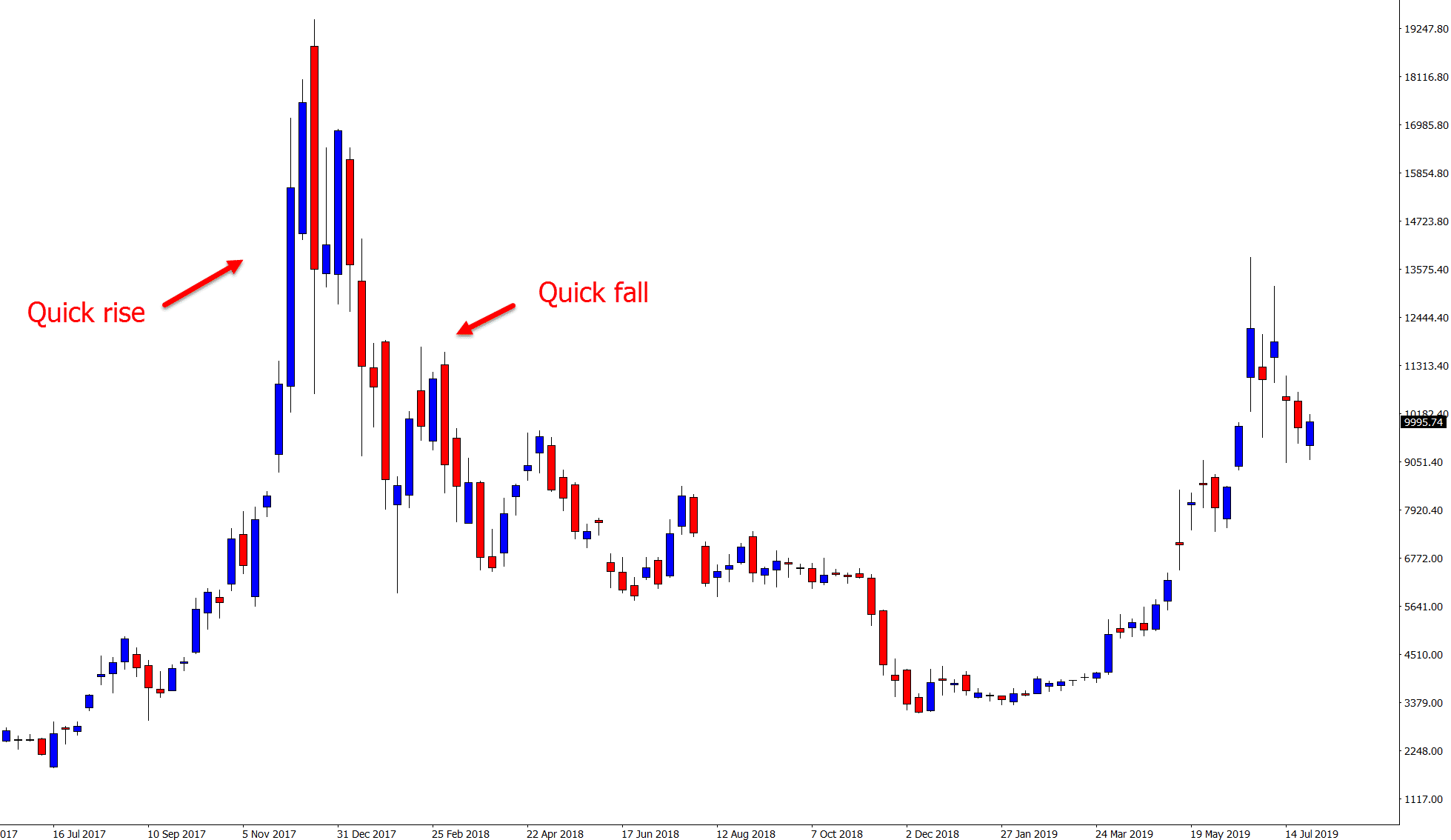
Price in Bitcoin went through an incredibly fast boom. After the price of Bitcoin grew over 2,700% to its peak in December 2017, it collapsed and lost 80% by December 2018. 

The cryptocurrency markets went on to lose 342 billion US Dollars market cap in just the first quarter of 2018.

As the image shows below; whilst not yet recovering to its former peak, the price of Bitcoin has made a rapid rise back higher in 2019 to recover some of these losses.
Bitcoin market crash


Other Notable Market Crashes

Whilst the five market crashes just discussed are some of the most famous and well known, there have been a lot of crashes throughout history that have defined the market.

A few of these are;

  • South Sea Bubble 1720
  • Panic of 1873
  • Asian Financial Crisis 1997
  • Global Financial Crisis (GFC) of 2007–2008


What We Can Learn From These Market Crashes

Professional traders know and understand that you cannot prevent having losing trades.

You can minimize your risks using different strategies and you can minimize your downside.

You can also use a good broker that is tightly regulated to carry out your trading strategies quickly and effectively so that your orders are executed fast and they get you the best prices.
 

What is Risk to Reward Ratio and How to Calculate it in Forex Trading

Risk reward is a simple concept, but how you deploy and use it in your trading can be as advanced as you like.

At its most basic, risk reward is the formula for how much reward you stand to make for the amount you are risking.

For example; if you risk 10 pips on a trade and you have a profit target of 30 pips, then your risk reward or RR is 1:3. You are risking 1 (10 pips), but stand to make 3 x times your risk (30 pips).


Should You Use High or Low Risk Reward?

You have probably heard that to increase your chances of being a profitable trader you should have a positive risk reward. This means that if you are risking 1, you should be making 2 or more times your risk on your winning trades.

This is great in theory because the higher your risk reward the less winning trades you need to make to achieve a profit.

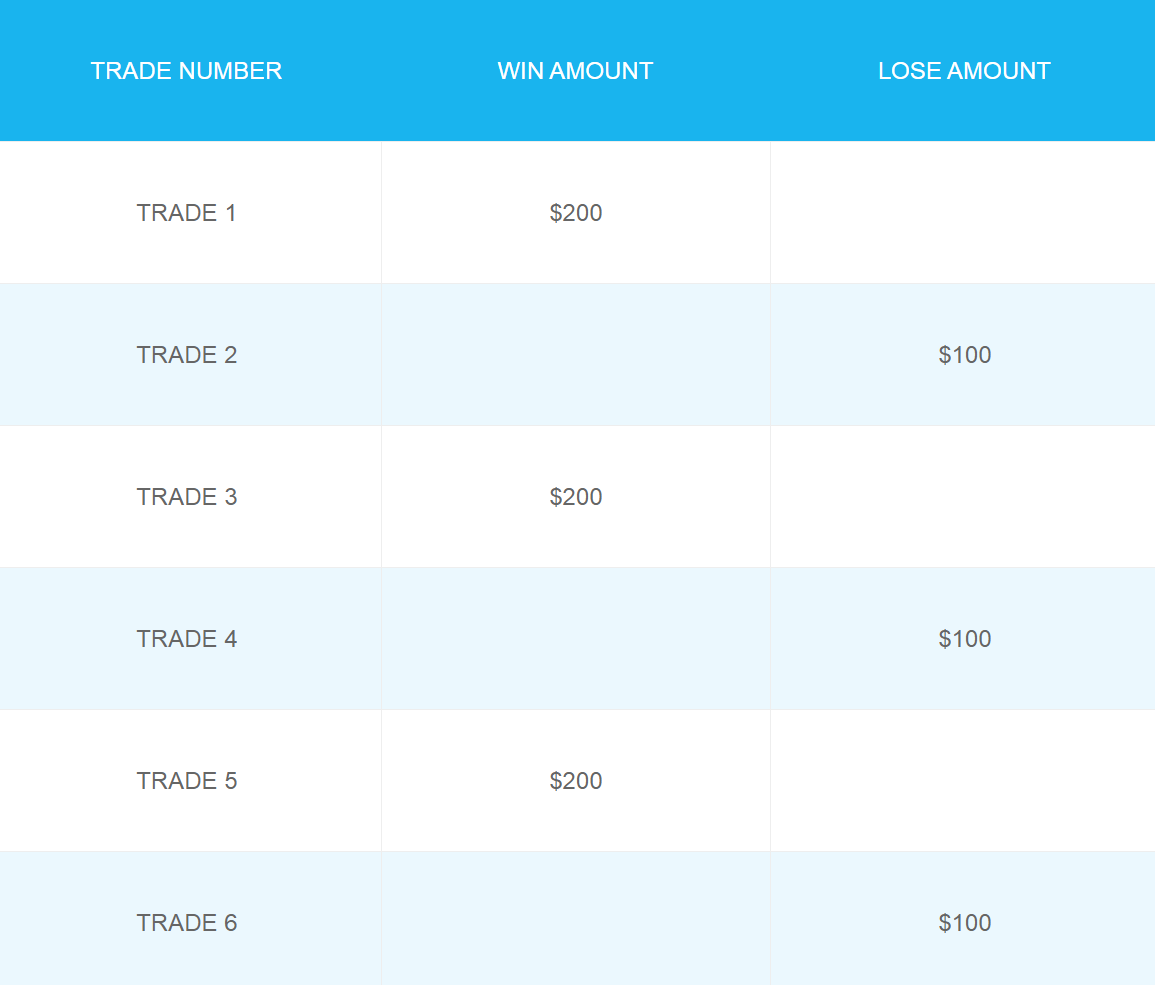
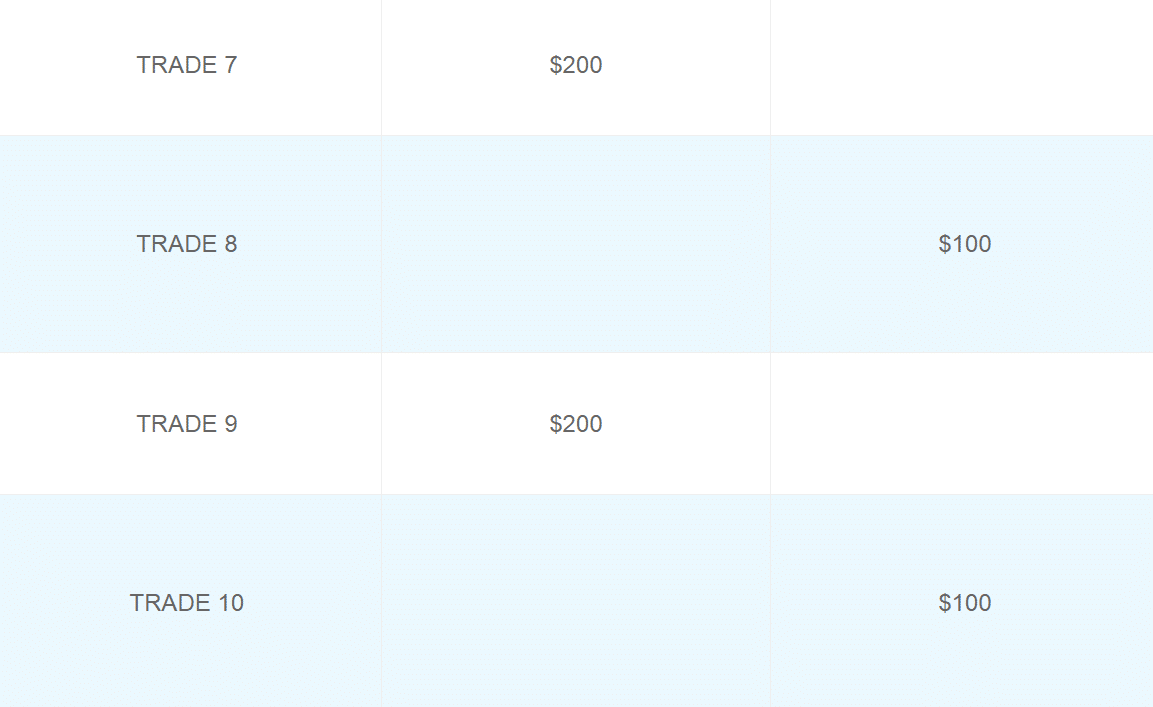
Below I have added a chart showing how having a risk reward of 1:2 can make you a profit even when only getting half of your trades right. In this example you are risking $100 when you lose and aiming for 1:2 reward or $200 when you win;

In the example given above; you are only winning every second trade, but after ten trades you have made $1,000 and lost $500, equaling $500 profit.

Whilst this is great in theory, the truth is that the higher risk reward and the bigger the winning trades you aim for, the more losing trades you will make.

This is simply because price is getting further away from your profit target the bigger the risk reward.

As we will discuss below; risk reward is important, but it is also only half the equation. You can have as big of risk reward on your winning trades as you like, but if your losers eclipse your winners, you will lose money.


Things to Consider With Your Risk Reward Strategy

Don’t Forget Spreads and Commissions

So far we have discussed straight risk reward. In the real trading world you need to factor in trading costs including spreads and commissions.

These play a very real factor in both the risk reward strategy you use and the trading method you will use.

If you are making a trade on the EURUSD looking to scalp a 10 pip profit with a 5 pip stop (1:2 risk reward), you will need to factor in your spread costs.

The spread could be 2 pips and you have a stop of 5 pips meaning you are really risking 7 pips. You are not actually achieving a 1:2 risk reward ratio.

Your Trading Strategy and Pairs You Will Trade

Spreads are not going to affect your risk reward as much if your not looking for very small pip profits on small time frames.

When thinking about the risk reward strategy you use in your trading you need to consider the trading method you are using and also the Forex pairs it is suited to.

Different pairs have widely different spreads. Whilst the major pairs such as the EURUSD and AUDUSD have far smaller spreads, the exotics can quickly have spreads that blow out.

If your strategy is intraday scalping you need to take this into consideration.

If however; you are trading daily charts and risking 50 pips to make 100 pips, then spreads will have far less effect on your overall bottom line.

Risk Reward is Only Half the Equation

As discussed above, what you average as your risk reward is only half the equation.

You can make money with a 1:1 risk reward (or less) and you can be a consistent loser with a 1:5 risk reward.

How? It does not matter if you have huge winners if these winners do not cover your losses. At the end of the week and month you are still losing money.

Your win rate must be factored into the equation when working out your risk reward strategy.


How to Calculate Risk and Reward With the Fibonacci Retracement Tool

Working out your risk reward is quite simple, but it can also be a time-consuming process.

Right on your MT4 or MT5 charts you have a tool that you can use to easily and quickly workout your risk reward to see if a trade is viable.

The Fibonacci retracement tool can be used to quickly calculate the potential risk reward.

To do this, go to your MT4 charts and open your Fibonacci tool; “Insert” > “Fibonacci” > “Retracement”.

Next you’re going to make some slight adjustments to how the Fibonacci tool operates.

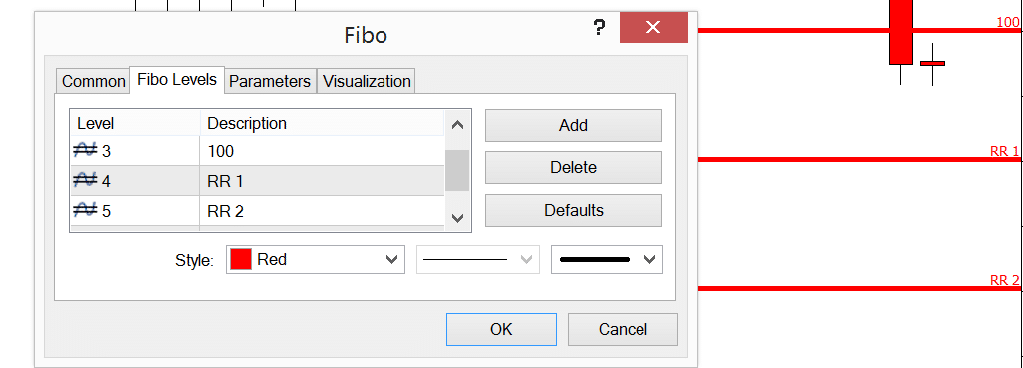
Click on the properties and when the settings box is open change the Fibonacci extensions to risk reward levels, for example 1,2,3 etc.

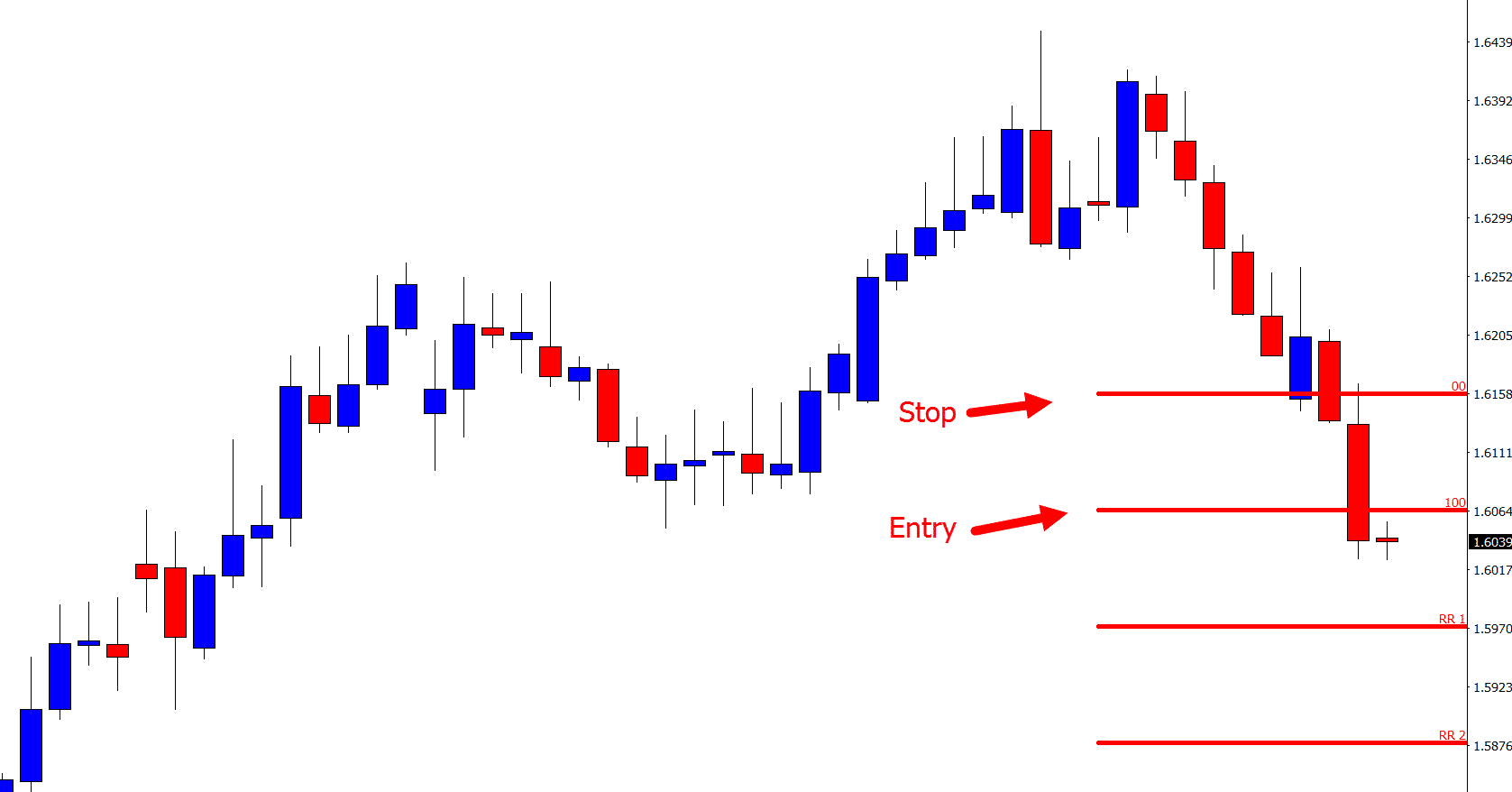
To use the Fibonacci tool to plot your potential risk reward you are going to use it upside down. This means that you start with level 100 as your entry and 00 as your stop loss.

Below is an example of how you could use the Fibonacci tool for risk reward with the entry, stop loss and targets as potential risk rewards.


Lastly

Risk reward is a crucial component of your money management strategy and overall trading success.

It is likely that the first risk reward strategy you try will not be the last, so practice the heck out of any new strategy and keep in mind your overall win rate in the equation.

Forex vs. Stocks – What Should You be Trading?

I am often asked about whether the stock market is similar to the Forex market and how both markets compare.

There are some huge differences between the Forex and stock markets that make them suitable to different sorts of traders and investors.

A lot of traders are attracted to the Forex market because it offers very minimal trading costs, you can start with a small amount of capital and there are large moves happening frequently. The markets are also open 24 hours a day offering a lot of trading opportunities.

The stock market also has its benefits, but is a completely different kettle of fish.

Today we look at what market you should trade, or if you should trade both. 

What are the Major Differences Between Stocks and Forex?

I have included a table below that discusses the major difference between the stock and Forex markets.


1: Market Size

Something that should interest you if considering what markets to trade is the size.

The Forex market trades on average $5.1 trillion dollars per day and is the largest market in the world. With this size it means prices are free flowing, there are a lot of trading opportunities and you will not have problems entering trades.

The stock market is far smaller with an average of around $200 billion dollars per day.

Whilst that might sound a lot of money, there are thousands of stocks to trade from and many of these stocks have wide gaps.

The Forex market is doing the bulk of its transactions through the major currencies such as the USD, GBP and AUD. This also means you will have less gaps and better execution prices.


2: Volume and Liquidity

Forex markets normally have tight spreads and low transaction costs.

The main reason for this is because of the high volumes of currencies being traded and the higher liquidity.

The stock markets have far less volume and liquidity that leads to higher transaction costs.


3: Market Opening Times

The currency market never stops. There are currencies being exchanged 24/7.

As an individual trader you will be able to make trades through a broker 5 days a week and 24 hours per day.

This leads to far less gaps and a smoother technical analysis picture.

Stock markets trade in 8 hour sessions. These sessions are dependent on the stocks country and their market trading times.

Because of the large amount of time in between each session, price can often open a new session far higher or lower than what it previously closed creating a large amount of risk for you as the trader.


4: Trading Costs

Most Forex brokers give you the choice of two pricing models.

With the first you can pay no commissions and pay the spread markup applied by the broker.

The second model is where you will pay a commission, but be offered far smaller spreads.

The spreads in the Forex markets are very transparent and you can see them before entering a trade and work out your trades cost.

When trading stocks you will normally pay commissions for both entering and exiting a trade, as well as paying the spread.


5: Amount of Markets / Pairs to Trade

As the Forex market has grown more and more popular, brokers have begun to offer more and more currency pairs to trade.

In saying that; there are only eight major currency pairs that trade by far and away the bulk of the Forex volume.

In the stock market there are 2,800 stocks listed on just the New York Stock exchange alone.

Trying to track literally thousands of different stocks, there fundamentals and technical picture, is a far greater task than watching 8 major Forex pairs.


Forex Markets Compared to Other Markets

Stocks are not the only markets you may have considered trading.

I am often asked about other markets because traders want to find more trading opportunities.

When trading through a CFD broker a lot of these markets operate in very similar ways to the Forex market with extended trading hours, smaller trading costs and bigger leverage available.

These markets include the major stock indices (not individual stocks), Oil, Gold and Silver.


Forex vs Stocks: Should You Trade Stocks, Forex or Both?

If you should trade stocks, Forex or both comes down to a few key factors.

Do you want to make more trades, have a lower capital outlay and few trading costs?

Or, do you want to invest in individual stocks, are happy to ride out the market waves and are not looking for short sharp trades?

If you like to make more trades and are suited to a large market that has plenty of volatility, then the Forex market is probably for you.


Recap

As an individual stock investor you will have to find, track and monitor thousands of different stocks. You will have to have a far larger capital investment to start with and be prepared for higher trading costs.

Whilst in the Forex markets there are dozens of different pairs, the bulk of the trading is done in only a few pairs making it far easier to find trading opportunities and perfect your trading system.


« Previous Page
Next Page »

Primary Sidebar

Forex School Online

High Probability Price Action Trading

How to make, manage and take profit from trades in the markets

Start Learning (It's Free!)

Turn Your Trades into Winners!

The Price action course is the in-depth advanced training on assessing, making and managing high probability price action trades.

Sign up for Free!

Recommended Broker

  • Broker
  • Min Deposit
  • Benefits
  • Score
  • Visit Broker

$200

T&Cs Apply
  • The Lowest Trading Costs
  • 50% Welcome Bonus
  • Award-winning 24 Hour Support
5
Trade Now FreeBets Reviews
Reviews

Footer

Get Our FREE Course, Bonus Strategies & Indicators!
X
Join Us Now!

Your capital is at risk.

X

CORNERSTONE LESSONS

Forex Trading for Beginners

Price Action Trading

How to Trade Forex

Technical Analysis

Forex Charts

Forex Trading Strategies

Money Management 

Compare Brokers

Best Forex Brokers

Forex Demo Accounts

Best Forex Trading Platforms

Forex Apps

Swap Fee Accounts

MT4 Brokers

CATEGORIES

Forex Videos

Trading Lessons

Weekly Trade Ideas

Start Here Guide

ForexSchoolOnline.com helps individual traders learn how to trade the Forex market

WARNING: The content on this site should not be considered investment advice and we are not authorised to provide investment advice. Nothing on this website is an endorsement or recommendation of a particular trading strategy or investment decision. The information on this website is general in nature so you must consider the information in light of your objectives, financial situation and needs.

Investing is speculative. When investing your capital is at risk. This site is not intended for use in jurisdictions in which the trading or investments described are prohibited and should only be used by such persons and in such ways as are legally permitted. Your investment may not qualify for investor protection in your country or state of residence, so please conduct your own due diligence or obtain advice where necessary. This website is free for you to use but we may receive a commission from the companies we feature on this site.

We Introduce people to the world of currency trading. and provide educational content to help them learn how to become profitable traders. we're also a community of traders that support each other on our daily trading journey

Forexschoolonline.com is not a financial advisor. Do your research before investing your funds in any financial asset or presented product or event. We are not responsible for your investing results.

Copyright © Forex School Online Sitemap  - Privacy Policy - Disclaimers & Terms of Use - CONTACT US