• Skip to primary navigation
  • Skip to main content
  • Skip to primary sidebar
  • Skip to footer

ForexSchoolOnline.com

Learn to Trade Forex Online

  • Compare Brokers
    • Broker Type
      • Paypal Brokers
      • Swap-Free Brokers
      • Low Spread Brokers
      • ECN / STP Brokers
      • Market Maker Brokers
      • Non Dealing Desk Brokers
      • Low Minimum Deposit Brokers
    • Country
      • Brokers for Australia
      • Brokers for South Africa
      • Brokers for the UK
      • Brokers for the US
      • Brokers for Nigeria
    • Regulation
      • FCA Regulated Brokers
      • ASIC Regulated Brokers
      • FSCA Regulated Brokers
      • CFTC Regulated Brokers
    • Platform
      • MT4 Brokers
      • MT5 Forex Brokers
    • Strategies
      • Hedging Forex Brokers
      • Scalping Forex Brokers
      • Carry Trade Forex Brokers
      • Brokers for Indicators and EA’s
  • Start Here
    • Start Trading Guide
    • Beginner Trading Lessons
  • Free Forex Course
    • Public Login
    • Register
    • Password recovery
  • Lessons
    • Strategies
    • Videos
    • MT4 Guides
    • Money Management
  • Trade Setups
  • Tools
    • Correct Free Demo Charts
    • Forex Journal Download
    • Position Size Calculator
    • FULL List of Tools
    • Forex Demo Accounts
  • Price Action Guide
  • Free Course

Best Types Forex Trading Analysis

There are many different ways to analyze the Forex markets to make trades. Whilst some people will be drawn to one over the other there is no one “holy grail” that will make you rich overnight. Many people come to Forex believing that it is a get rich quick scheme. Forex is NOT a get rich quick scheme and people who treat it as such will fail.

Forex is a business and only the people who treat it as a business, and are serious about their trading will have success. If you are looking to get rich quickly, I advise you to go to the casino or somewhere else to gamble. If you are serious about trading Forex, and you want to treat trading like a business, you have come to the right place!

Whilst there is no one right way to make money in Forex market, there are easier methods than others. Over the years the one thing that has stuck out to me is how hard and complicated traders try to make trading. Quite often traders who are struggling believe they are struggling because they are missing something, or are not looking far enough into it.

This is quite often the exact opposite. The more traders complicate things, normally the worse their results will be. The best trading methods in the world are both logical and simple.

To understand what methods are the best to trade Forex, you have to understand what other methods and systems others are using. Below you will find the most commonly used trading methods used throughout the world.

Forex analysis

Fundamentals

Fundamental analysis is all about taking the current status of each country’s economic balance sheets and trying to find currency pairs that are cheap or expensive. A trader who uses fundamentals will also rely heavily on news announcement to guide them in their trading.

The major problem with trading with the news and fundamentals is the price of a currency pair rarely if ever reacts to which way the news announcement went or the fundamentals. The reason for this is traders are buying and selling everyday on what they think will happen. By the time the news is released, the currency prices have already had this news release factored into them. This is what many refer to as “buy the rumor and sell the fact”.

All this means is by the time the news is released the currency in question has already had the announcement factored into the price and will often move the opposite way to what would be expected.

Forex news and fundamentals

Robots/EA’s

Trading with Robots and Expert Adviser (EA’s) is very common with new traders. Because new traders are often on the hunt for the Holy Grail, they go looking for a robot to trade for them. All a Forex robot does is make trades by itself using certain criterion that has been inbuilt. You can buy Forex robot’s or make your own.

The simple fact is Robot’s and EA’s rarely work and none of them do for very long. The market is constantly changing which means even if one robot is profitable now; the chances are that it won’t stay that way for long.

The reason that a lot of new traders use EA’s and Robots to trade is that they are uneducated and fail to realise that the best asset they have in the markets is their mind. The human mind can adapt and change to the ever changing market dynamics which is needed to succeed.


Indicators

Trading with indicators is a very slippery slope that normally ends with confusion. Like trading robots indicators are very popular with newer traders. Indicators are what traders can place on their chart to help them in their decision process. Examples of indicators are moving averages and MACD.

Indicator

The reason indicators are a slippery slope is it is impossible to know when a trader has enough or too little. A common example is a trader starts with one or two indicators. They luckily make a winning trade using these indicators. The next trade they lose and they think to themselves “If two indicators helped me make a winning trade, using another one will help even more”, and so the trader adds another indicator.

What ends up happening is the chart becomes a mess with indicators all over it and the trader can no longer see what is happening with the price. The trader then becomes confused because they have so many indicators that will start to contradict each other. It will end with a trader suffering from “analysis paralysis” and a very confused trader no better off than at the start of their journey.

Professional traders tend to stay away from indicators and concentrate on a simple method that focuses on price movement and key levels in the market.


Technical Analysis

Traders that use technical analysis are using price charts, price patterns and sometimes indicators to help them make trading decisions. Whilst traders using fundamental analysis are using news and economic reports to make trading decisions, technical traders are only interested on what is happening on the charts.

A few common chart patterns technical traders use are:

– Head and Shoulders

– Double top/bottom

– Cup and Handle

– Rising and Sloping Trend Lines

And a few common indicators use by technical traders are:

– Moving Averages

– MACD

– Average True Range (ATR)

– Relative Strength Index (RSI)

Within technical trading there are many different types of trading methods to be used. One of these methods is Price Action trading, which is the system of using only raw price for analysis. Price Action involves trading high probability price patterns that form regularly. More information on price action and how you can learn to trade price action can be found in later chapters.


Sentiment Analysis

Sentiment analysis is a valuable tool, but at the same time is not substantial enough to be a stand-alone type of analysis that you can base your Forex decisions. Sentiment analysis is more of an auxiliary type of analysis that you probably should add to your own analysis to make it more robust.

Sentiment analysis imply trying to assess and understand the general mood in the markets, what traders are thinking and what their expectation are. A good starting point for that is Twitter or Facebook, so you can go on twitter and search a currency pair and see what people are thinking, what they’re talking about; or any type of social network including Forex forums.

This is important because at the end of the day people make transactions in the market and it matters what people think, especially when it’s a lot of people thinking about the same trading idea. We have to keep in mind that it’s not always purely sentiment that drives the market, but it’s good to assert it and keep it in the back of your mind.

Also, sentiment is reflected often in currency pair behaviors and eventually you’ll learn how to pick it up from the charts. For instance, when traders are uncertain and they’re nervous you’ll see consolidation on the chart.

Since 95% of traders lose money when we have a majority of traders that are in agreement about the direction of a certain currency pair usually, the market goes the other way and that’s why to a certain degree sentiment analysis can be used as a contrarian indicator.

The majority of Forex brokers will provide you with an indicator that measures their clients’ sentiment and it will show you the long and short ratio in the most popular currency pairs. For example if 85% of retail traders are long EUR/USD this is a clear indication of a crowded trade and it’s best to look for sell signals in the market.


Choosing the “Right” Type of Forex Analysis

There is no right or wrong method to analyse the market. What is most important is to choose one type of Forex analysis that is compatible with your own personality and that makes more sense to you.

Technical analysis remains one of the most popular methods of analyzing the markets among retail traders because of it’s great timing in the market.

Price action as we know it has been traded and used successfully in many different markets for literally hundreds of years. Since the 1800’s traders have been using different forms of candlesticks and price action to determine order flow and trader behavior to get a jump on their competitors.


God of price action


This does not mean that price action trading is the only method to trade by any means at all, but if you are thinking about learning to trade price action, you could to a heck of a lot worse than learn a trading method that has been working for a couple of hundred years now.

 

Related Lessons:

– How to Trade Double Tops

– How to Trade Breakouts

– How to Find and Trade the 1,2,3 Pattern

Forex Money Management & Position Sizing

When people first come to trading and in particular Forex the first thing they look to do is find the shiniest and fanciest trading system they can get their hands on. The thinking goes that if they can just find the latest and greatest system all their dreams will come true and the millions will come rolling in.

Whilst a solid and profitable trading method is needed to make money trading, if the trader does not use a profitable money management technique to fit that system or method then the best trading system in the world is not going to help them.

The best trader in the world could personally tutor and give a trader all their tricks and tips, but if that trader fails to use solid money management, then they are still doomed to fail! This is how important money management is and it is something that is constantly overlooked.

It takes many months in most cases for traders to search through system after system to realise that after all the systems have failed that maybe it is not the system, but something else they are doing that causing them to consistently fail.


What is Money Management in Forex?

Basically exactly as it says; Forex money management is how you manage your money when you trade. When discussing money management in Forex, traders are normally referring to how much they are risking of their account. For example; trade Joe may say: “I am risking 2% on this engulfing bar trade”. This means that if Joe was to lose his trade he would lose 2% of his overall 100% account.

It is important that all traders have a money management technique and that it is carried out with consistency. Below I will speak about this in more detail and why I am not a fan of the fixed percentage.


Forex Cash


One of the most important aspects of money management is ensuring that the traders live to trade another day no matter what happens on any one individual trade. Anything can happen at any time in the markets and using a sensible money management technique ensures that the trader will be able to trade again no matter what happens.

A major reason that traders will fail even when using a profitable trading system is because the money management they are using simply does not give their systems edge long enough to play out over time. Traders must think like a casino when trading.

A casino knows they will lose games and also know they will have losing runs of games, but the casino knows that in the end they always come out on top. The casino factors in how much they can risk to ensure that in the end they will make money. This is exactly what traders have to do to ensure that no matter what happens and no matter what losing streaks they have, they give their profitable trading method time to play out by using a money management technique that keeps them in the game.


How to Work Out Trade Position Sizes

After the trader has decided how much they wish to risk each trade, it is important that they then before entering each trade work out how much the position size should be. Something I am regularly amazed at that traders don’t know exists is position sizing. This consistently surprises me as this one technique is so important and yet overlooked and not known to so many traders.

Position sizing is important because it allows traders to adjust their trade size depending on the factors of the trade such as the pair and stop size. I often get told by traders “I can’t trade the higher time frames because I don’t have enough money” and this is exactly what position sizing solves. Working out the position size allows traders to make bigger or smaller trades depending on the different trades circumstances.

Every trade a trader will enter will have a different size stop. If a trader is to enter the same amount on every trade no matter what the size stop is they would be risking vastly different amounts of money and different percentages of their account every single trade.

For example; if a trader put a 50,000 trade on with a 20 pip stop they are risking twice as much as if they enter the same 50,000 with a 10 pip stop.

So a trader can enter every trade risking either the same amount of money or the same percentage of their account for every trade, position sizing is used.

Using position sizing ensures that a trader will be able to place a trade and risk the same percentage of their account whether the stop is 200 pips or two pips. This also ensures that no matter how small the traders accounts are they can play trades with large stops, providing their brokers allow them to use leverage and small units.

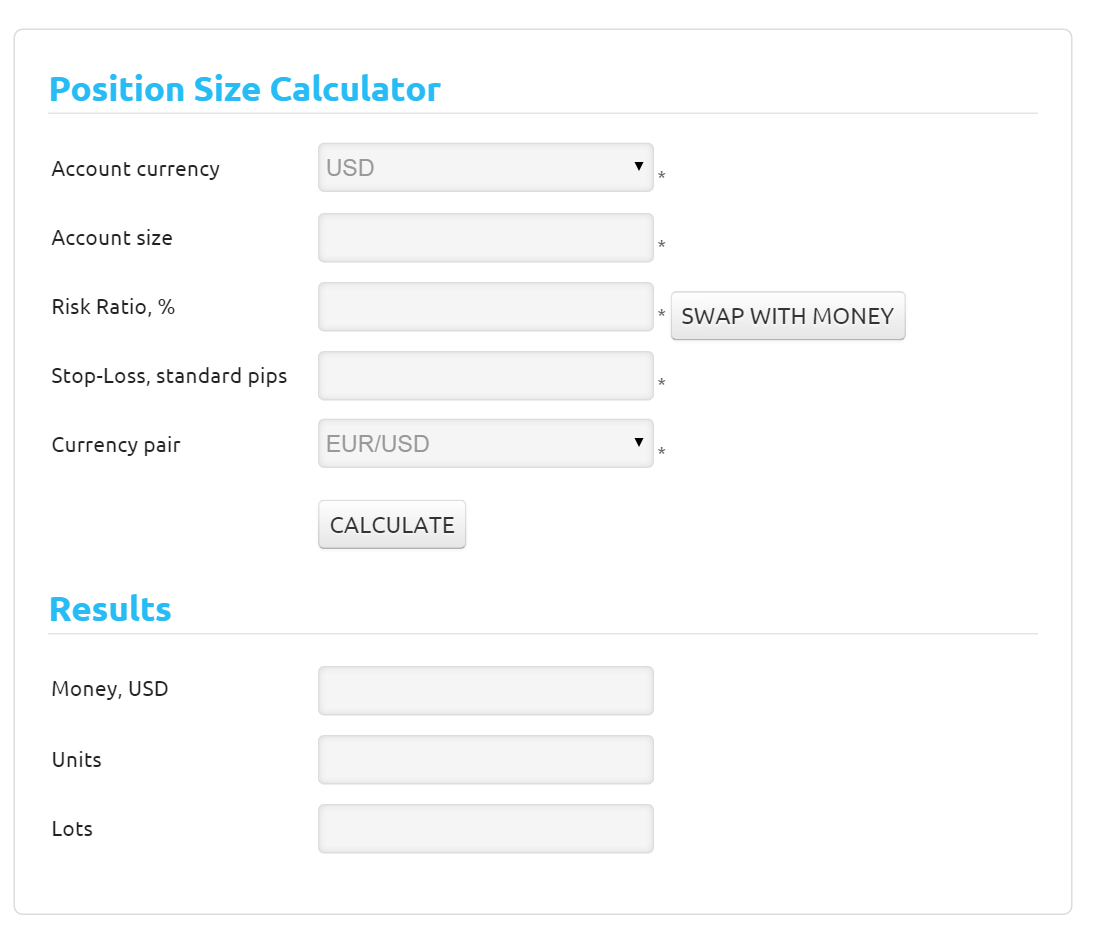
To work out the position size before each trade we use what is called a position size calculator which can be found here: Position Size Calculator

The calculator asks questions which will need to be filled in such as: account currency (the currency of your trading account), account size (your account size in $), risk ratio is either % or $ (how much in $ or % you want to risk), stop loss in pips (how big your stop is), currency pair (the pair you are trading).

After these questions are filled in, you will be given your answer of the amount you need to trade to risk the amount you input into the risk section. The results come back as: money (how much money you are risking in this trade), units and lots (how big your trade size is on units and lots). This is the amount you will then open a trade with.

For example; if the calculator comes back with Money: 200 Units: 20,000 and Lots: 0.2 it means you will be opening a trade for 0.2 lots. One full standard lot or standard contract is 100,000, so 0.2 lots of one standard lot are 20,000.

A picture of what the position size calculator looks like below:

Forex position size calculator

Why Fixed Percentage is Flawed & a Few Money Management Keys!

A lot of retail traders use the commonly used money management method that is commonly called the fixed percentage method that we touched on above. This method is basically all about using the same percentage risk every trade no matter what the size stop for each and every trade. For example; trader Joe may risk 3% on every one of her trades and she will risk this same 3% no matter whether the stop on her trade is 30 pips or 300 pips.

The percentage risked will stay the same whether trading on the 1hr chart or the weekly chart. The idea behind this method is that it keeps the trader in the game. If the trader goes on a losing streak the amount of money risked continues to get smaller because the account size gets smaller, but the percentage of the account risked overall stays the same.


Fixed percentageThe problem for this method is that if the trader starts losing, it makes it harder and harder to get the account balance back to break even and make money. Because they are using a fixed percentage, if the traders starts losing the account starts getting smaller. If the account starts getting smaller the amount of money they are risking starts getting smaller and smaller and the amount they start profiting gets smaller and smaller until the wins are not covering the losses.


If a trader loses 50% of their account with the fixed percentage method they don’t just have to make back 50% to get back to break even. They have to make back 100%!


So What to do?

When you consider that most traders trade with an account balance less than $10,000 it shows that the fixed percentage model is even more flawed. Another less well know method to manage money is the fixed money method.

The fixed money method is where the trader risks the same amount of money every single trade rather than risking the same percent. The trader picks a certain amount of their account that they are comfortable risking every trade. It is important that this amount is reasonable and that the trader can also take enough losses, but also stay in the game long enough for their trading edge to play out. For example; trader Joe who risked 3% of her $10,000 account, may instead be more comfortable risking $300 of her account each trade.

With this method if trader Joe loses a few trades and the account balance goes down, instead of the amount of money she is risking going down also and making it harder to get back to break even, she will continue to still risk the same $300 every trade.

Using the fixed percentage money method it is important that traders set goals in their trading journal and plans so that when these goals are reached they can increase the amount of money they risk per trade. This way the best of both worlds can be had; the trader can bet back to break even after any losing streaks as quick as possible, whilst taking advantage of the winning streaks when they come.


Related Trading Lessons

– Position Size Calculator

– How You Can Transform Your Trading by Creating a Profitable Forex Edge


A Guide Into How You Can Trade Price Action Everyday

Price Action Trading Strategy Introduction


When I very first started trading I quickly and swiftly fell in love with indicators.

This was very easy to do. As soon as I had found, learned how to use and started trading with the latest indicator, I was soon moving on and onto the hunt for the next indicator that would help me in my never ending quest of confusion which you will fully understand in just one moment.


The ‘Holy Grail’

A huge reason traders get stuck with indicators, expert advisors, robot systems etc, for so long before breaking away is because of the mindset that they instill. They breed a mindset of not only getting rich quick, but of the continual search for the ‘Holy Grail’ or silver bullet to fix all problems and be the answer to everything all at once.

There are literally right at this very moment millions of traders in forums, trawling websites looking for the magic system or indicator. It can often take a lot of losing and searching before a trader will start to see that the Holy Grail is alive, but it is not what they first thought.

The Holy Grail is not an indicator that you turn on and it makes you a million dollars overnight, it is learning how to trade so that you can become successful long-term and make money with an edge over the market that will not one day just stop because the market conditions changed.


The Responsibility Palm Off

The very appealing factor to indicators, expert advisors, black box systems and the like is that traders are looking to something else other than themselves to make the trade call and decision. What I mean by this is that, traders often look to take the psychological burden or weight off their shoulders.

Instead of taking responsibility for the decisions they make and learning how to lose properly (which is a major part of trading), often traders will learn how to hide behind other things or follow others or use indicators so they can internally blame them if things don’t go their way.

When the trade wins they can tell themselves internally “Great job, you picked a great winner”, but if the trade loses, they have the indicator to look at and palm the blame off to for pointing them in the wrong way.


When I First Started Trading I Run Into a Huge Problem!

The problem I was facing when I very first started trading and that a lot of traders face with indicators is that more often than not they are not used to help ‘indicate’ any situation. They add confusion upon confusion and the more confused a trader gets about indicators, the more they think they need indicators.

The more confused a trader gets about indicators, the more they think they need indicators.

What often starts as a hunt to learn as much as possible, will end in the first indicator being used. From here the trader will often make a winning trade followed by a loser or two.

The question will be asked as I also asked myself “If one indicator helped me pick the correct direction, then another one must be even better, and another after that, and another, and another etc, etc,” until the chart is a bomb site.

Either consciously or subconsciously this is a very important factor. The reason traders like signal services or why sites like Etoro are so huge and also why traders are always comparing against each other is because they find it EXTREMELY DIFFICULT to go out 100% by themselves and make all their own trade calls looking to no one else at all.


Why do You Need to Know This Stuff?

I bet you are asking that question right?

Unfortunately not many traders either believe it, or they believe it and don’t do anything about it, but the major cause for traders failing to become successful is they are unable to make great decisions time and time again.

Simple examples of this are; 1: A trader puts on a trade and does not follow their plan to take profit when they should and price turns around and stops them out for a loss instead of banking a profit, 2: A trader does not execute their stop loss when they should and their stop blows out way larger than it should, 3: A trade forms that fits perfectly, but the trader does not take the trade because they are scared from the previous 4 losses in a row they have had and watch this new trade turn into a large winner that would have put them back into profit.

There are 3 x examples of simple decision making errors that traders are making every single day over and over again. Traders are making trading rules and trading plans and then breaking these rules the very next trade.

The reason I have started this lesson with this information first is because you can learn all the price action trading strategies back the front and sideways, BUT if you don’t make great decisions and if you don’t stick to your plan and be disciplined, then you may as well be flipping coins.

It is my job in this guide to make sure you have the best understanding of what it is you need to do and where you need to go from here to have the greatest chance of success.


The God of Price Action

I am often asked if price action is either ‘old fashioned’, if the price action trading method is “out of date” or if it will continue to work in the coming years.

Now, obviously I cannot predict the future. For all I know the markets could collapse making all methods useless. So, before I go making silly statements or predictions, let me give you a little background information so that you understand the history of price action and then you can learn exactly how to start making price action trade setups.

Let me introduce you to the “God of the Candlestick” or the “God of Price Action” as we know it today!

Candlestick charts or ‘price action’ as we know it have been around since the 1800’s since the Japanese man Honma Munehisa who used these charts to make a fortune on the rice markets.


Candlestick chart god


A lot has changed since these early days, but in a lot of respects a lot has stayed the same.

Price action has been around for hundreds of years and whilst computers are now in the markets more than they have ever been, price action trading is the most common form of trading amongst professional traders.

Price Action trading involves analyzing just the raw price action data on a clean chart with no indicators whatsoever.

What so many traders fail to realize is that the indicators they are using in their trading are built from using old price data to give them a lagging indicator. Price Action traders are taking the live price, as it is continually being printed onto their chart, and making trades.


What is Price Action?

Put very simply;

Price Action trading is the skill of being able to read the price and make trades on any chart, in any market, in any time frame, and without the use of any indicators at all.

Price Action is everything that price is doing on any trading instrument, being represented on a chart for a trader to see.

In very basic terms, Price Action illustrates in a way that a trader can see exactly on a chart what a certain pair did for a particular time frame.

For example, the individual candle sticks or bars will show how high the pair went, how low the pair went, and also, the open and closing prices. Most charting platforms can produce candle sticks and bars for time frames varying from 1 minute to 1 month.

Another way to think about it is; Price Action is everything traders are doing and how they are doing it, shown in a chart form.

This basic explanation of Price Action is not subjective. What I see on my chart is exactly what another trader will see on their chart, providing they are using the same charting equipment.

Below is a chart showing a really clear example of a price action chart that you want to be using in your trading.

Notice how the only thing on this chart is a strategically placed support level and NOTHING else? There is not a heap of indicators and moving averages crossing over and who knows what going everywhere. The price is the most important factor and we need a clean chart, so that we can analyze the price action story.

An example chart of how a lot of traders have their charts set up with indicators and mess everywhere:

Indicator mess chart


An example of how a price action trader has their charts setup with a major emphasis on the price action:


Price action chart

What is a Price Action Trading System?

Price Action trading is a method that is commonly used by professional traders. Most professional traders use a very logical system that is not complicated, whereas most amateur Forex traders are hung up looking for the “Holy Grail” system and indicators that will bring them all their riches overnight.

Price Action is a system that is very logical and has clear rules in place. Instead of using indicators that cannot adapt to different types of markets, price action involves the trader making trades based on key signals forming in the market. Traders have been using price action in different markets for literally hundreds of years to trade with.

Price action was first traded successfully hundreds of years ago. The same just cannot be said for other flash-in- the-pan methods. Price action trading is a logical trading method that has been around for a long time and will continue to be around for a long time to come.


How Can You Use Price Action to Consistently Profit?

Price Action traders are using the information gained from the price action chart to make their trading decisions. Traders have their key signals that they are looking to present in the market for them to make a trade.

A few examples of what a price action trader is looking for in their charts are:

– Has price formed a false break?

– Is there a trend?

– Is there a range?

– Is price at or near a major support or resistance level?

– Has price formed a key reversal trigger signal indicating that the market is going to make a move?

Using the price data, the price action trader can plot the key supply and demand levels on their charts. They can also identify when price is about to either break out or reverse, and they can use this information to take profitable trades.


What are the Types of Trades Price Action Traders Take?

Price Action traders are constantly assessing price for any “Trigger Signals” they could use to take a trade or manage open trades. Price action traders use key candlestick patterns at key areas on their charts to enter into trades. One example of a price action trigger signal is the Pin Bar.

The Pin Bar is a reversal signal that can be found on any chart and on any time frame. A Pin Bar is a powerful price action signal when entered from the correct areas on the chart, and it is made up of 1 candle. Pin Bar’s can be used to pick both long and short trades (buy or sell) and will often be the signal to change the current trend or momentum. The Pin Bar is just one price action pattern of many that the price action trader can use. Other price action setups can include engulfing bars, 2 bar reversals, inside bars, continuations, breakouts, and false break patterns.

A Pin Bar must have:

– An open and close within previous bar

– A candle wick a minimum of 3 times the length of the candle body

– A long nose protruding from all other bars (must stick out from all other candles)

Below is an example of a bearish Pin Bar:

price action trading pin bar

Not all Pin Bar’s are created equal. Price Action traders use more than just the last candle to decide whether to take a trade or not. The whole price chart is information that the trader will take in when deciding to make a trade or not. The very best Pin Bar’s will be traded when they are with the obvious trend and at key support or resistance levels in the market.

Below is an example of a Pin Bar at a key resistance level.

Price action pin bar


What Else do Price Action Traders Use to Make High Probability and Low Risk Trades?

As I said above, Price Action is more than just looking at the last candle or the trigger signal to make a trade. That is what pattern traders do, but successful price action traders use the whole chart to make trading decisions.

Price is always telling us something, and learning how to use that information is critical in learning how to read and trade the whole price action story.


Trend Trading

When trading with the trend, traders are looking to take trades in the direction of the current trend. Whilst a very simple strategy, it is quite often overlooked by many traders. You most likely have heard of sayings, such as “The trend is your friend until it bends”, and this is very true. The best trades will be found when trading with the trend. The very best way to start increasing your chances of placing winning trades, and also, having those trades be bigger winners when they do win is to always trade with the trend. It is simply amazing how often this super simple, yet super powerful strategy gets overlooked.

The best trends to be trading with are the most obvious ones because the more obvious they are to you, the more obvious they are to everybody, and it also means that they are strong and clear cut. When trends are hard to spot and you are unsure if price is or isn’t trending, then you have to question the strength of the momentum.

There are many methods for identifying both trends and trend changes, but all that is needed is price action and nothing else. NO other indicators or fancy black-box systems or moving averages are needed. A price action traders’ job is to learn how to not just make entries, but read the whole chart including the trend, trend changes, and other market types.

You can learn more about how to identify and trade with price action trends including how to spot and use the 1,2,3 trend reversal strategy in the trading lesson, How to Trend Trade Price Action for Profits


Chart Example – Obvious Down-trend, With Lower Highs & Lower Lows

Trend Trading

Chart Example – Very Obvious & Clear Cut Up-trend Obvious up-trend in price action


Support and Resistance Levels – Price Action Story

Even more important than the trend direction is the key support and resistance levels. The reason support and resistance is so important is because that’s what the rest of the market is also looking at, and also, because these levels are acting or working as major areas of supply and demand.

Forex is the best market in the world for support and resistance. A huge reason for this is mainly because of the size of the market with the turnover regularly exceeding 5 trillion dollars each day. That is why Forex is so popular as a market to trade, and also, why the major support and resistance levels get so well respected time and time again.

Whilst major support and resistance levels will not always hold, they will very often act as key levels to make highly profitable trades from. The reason behind this is because, as I hinted to above, they are acting as supply and demand levels.


Supply and Demand

Just as in everything we purchase in real life, from the apple at the green grocer to the meat we buy at the shops, has it’s price determined by supply and demand; so does Forex.

The simplest way to explain this is to give an example. A few years ago in Australia, we had a banana shortage. All of a sudden, there was a real shortage of bananas. There was a huge demand, but the supply could not meet it. The price went from the normal $2 per kg. to over $11 per kg.

This sort of supply and demand equation happens in every market, and it happens both up and down. If there is an oversupply with too much of one thing and not enough buyers like we have had in oil of late, then price goes down.

The Forex market works exactly the same, and that is what price action traders are looking at with their support and resistance charts. Price Action traders are constantly looking for key support and resistance levels to trade from.

The reason a price action trader is looking to make a trade from a major support or resistance level and not just in the middle of nowhere, and he/she is also trying to pair that support/resistance level with a trend if they can. is because the support or resistance level is where the major supply and demand levels are.

Example chart of price bouncing between both support & resistance


support & resistance


Bulls and Bears – Support and Resistance/Supply and Demand

Bulls & bears supply and demand Forex trading


As I have just explained above about supply and demand, all the big order flow and big supply/demand that is going to give price the big push is sitting at the major levels. That is why especially pairing a support or resistance level with a strong trend can be a super powerful combination.

To make a successful high probability trade setup, price action traders need to plot these support and resistance levels beforehand. When price then gets to these levels, it is about waiting for price to make a trigger signal, and then pouncing quickly.

I recommend you read my trading lesson on exactly how to markup your support and resistance levels, the routine you should be using in your trading, and the time frames that are the best for support and resistance. Check it out here:

The Ultimate Guide to Marking Support and Resistance on Price Action Charts.

And you can find a lesson on making trades from supply and demand levels at:

Supply and Demand – The Key to Where Price Moves

Below is a chart example of obvious support and resistance levels:

Below is an example of how a trader can use these support and resistance levels to make a trade. The chart shows a Pin Bar trigger signal that has formed at a key support level. Price then rejects the support level and moves higher.

Below is a chart example of obvious support and resistance levels:


Below is an example of how a trader can use these support and resistance levels to make a trade. The chart shows a Pin Bar that has formed at a key support level. Price then rejects the support level and moves higher.


The False Break

There are a lot of different price action pieces of information that a trader can use, such as candlesticks, different patterns, momentum, etc, but one of my all time favorites is the false break.

The reason the false break is one of my favorites is because it is super powerful and can be used to be traded on many different time frames including the smaller time frames.

The false break is not just one particular trigger signal in itself (although it can be), but a market movement where the market is “Faked Out” the wrong way.

The best way to explain the false break is with a chart example. All false breaks, whether they are one candle or a couple of candles, need a major support or resistance level to be making a false break of. This is important. The level needs to be an important one. Make sure you first have a major support or resistance.


Chart Example – Bearish False Break

As the chart shows below, the false break starts with price breaking out higher and through the resistance level. When price breaks out higher, the breakout traders who have been sitting and waiting for price to breakout higher now jump into the market and start buying, taking long trades.

There is a quick snap back lower. This can be started off by the first buyers taking profit or for another reason, but what it does do is start to set up the false break. A big portion of the market have all jumped into long trades, and these traders now all have their stops sitting just below where price is.

As price starts to reverse, all these stops tend to be like fuel to fire and that is why false breaks can be so powerful and move so quickly once they start and gain momentum. They will often start slow, and then build really quickly.


Chart 1 – Price breaks out

False Break


Chart 2 – Price snaps lower

Price snaps lower - false break

Chart 3 – False break in full swing

False break momentum


Related Trading Lessons

– The Ultimate Guide to Marking Support and Resistance on Price Action Charts

– How to Trend Trade Price Action for Profits

– Supply & Demand – The Key to Where Price Action Moves


« Previous Page
Next Page »

Primary Sidebar

Forex School Online

High Probability Price Action Trading

How to make, manage and take profit from trades in the markets

Start Learning (It's Free!)

Turn Your Trades into Winners!

The Price action course is the in-depth advanced training on assessing, making and managing high probability price action trades.

Sign up for Free!

Recommended Broker

  • Broker
  • Min Deposit
  • Benefits
  • Score
  • Visit Broker

$200

T&Cs Apply
  • The Lowest Trading Costs
  • 50% Welcome Bonus
  • Award-winning 24 Hour Support
5
Trade Now FreeBets Reviews
Reviews

Footer

Get Our FREE Course, Bonus Strategies & Indicators!
X
Join Us Now!

Your capital is at risk.

X

CORNERSTONE LESSONS

Forex Trading for Beginners

Price Action Trading

How to Trade Forex

Technical Analysis

Forex Charts

Forex Trading Strategies

Money Management 

Compare Brokers

Best Forex Brokers

Forex Demo Accounts

Best Forex Trading Platforms

Forex Apps

Swap Fee Accounts

MT4 Brokers

CATEGORIES

Forex Videos

Trading Lessons

Weekly Trade Ideas

Start Here Guide

ForexSchoolOnline.com helps individual traders learn how to trade the Forex market

WARNING: The content on this site should not be considered investment advice and we are not authorised to provide investment advice. Nothing on this website is an endorsement or recommendation of a particular trading strategy or investment decision. The information on this website is general in nature so you must consider the information in light of your objectives, financial situation and needs.

Investing is speculative. When investing your capital is at risk. This site is not intended for use in jurisdictions in which the trading or investments described are prohibited and should only be used by such persons and in such ways as are legally permitted. Your investment may not qualify for investor protection in your country or state of residence, so please conduct your own due diligence or obtain advice where necessary. This website is free for you to use but we may receive a commission from the companies we feature on this site.

We Introduce people to the world of currency trading. and provide educational content to help them learn how to become profitable traders. we're also a community of traders that support each other on our daily trading journey

Forexschoolonline.com is not a financial advisor. Do your research before investing your funds in any financial asset or presented product or event. We are not responsible for your investing results.

Copyright © Forex School Online Sitemap  - Privacy Policy - Disclaimers & Terms of Use - CONTACT US