• Skip to primary navigation
  • Skip to main content
  • Skip to primary sidebar
  • Skip to footer

ForexSchoolOnline.com

Learn to Trade Forex Online

  • Compare Brokers
    • Broker Type
      • Paypal Brokers
      • Swap-Free Brokers
      • Low Spread Brokers
      • ECN / STP Brokers
      • Market Maker Brokers
      • Non Dealing Desk Brokers
      • Low Minimum Deposit Brokers
    • Country
      • Brokers for Australia
      • Brokers for South Africa
      • Brokers for the UK
      • Brokers for the US
      • Brokers for Nigeria
    • Regulation
      • FCA Regulated Brokers
      • ASIC Regulated Brokers
      • FSCA Regulated Brokers
      • CFTC Regulated Brokers
    • Platform
      • MT4 Brokers
      • MT5 Forex Brokers
    • Strategies
      • Hedging Forex Brokers
      • Scalping Forex Brokers
      • Carry Trade Forex Brokers
      • Brokers for Indicators and EA’s
  • Start Here
    • Start Trading Guide
    • Beginner Trading Lessons
  • Free Forex Course
    • Public Login
    • Register
    • Password recovery
  • Lessons
    • Strategies
    • Videos
    • MT4 Guides
    • Money Management
  • Trade Setups
  • Tools
    • Correct Free Demo Charts
    • Forex Journal Download
    • Position Size Calculator
    • FULL List of Tools
    • Forex Demo Accounts
  • Price Action Guide
  • Free Course

How to Create Rule Set & High Probability Edge Over Market

There is one thing all professional traders have in common and that is they all have a trading plan.

The reason a trading plan is so important is because the plan is what a trader uses to make their trades, manage their trades and take profit out of the markets systematically.

A trading plan is just like a rule book that includes all the information on how a trader trades. Having a solid trading plan will ensure you are consistent in you trading and follow your rules – or not.

Trading Forex is very different from every other job in the world because there are no rules. There is no one telling you how much to trade, when to trade or how to trade. Rules are very important to a trader because without them they are just another gambler.

Another way to think about a trading plan is a business plan. The plan outlines how your business runs and operates.
trading plan


What Should a Trading Plan Contain?

A trading plan and rules needs to cover every scenario you are likely to encounter when trading.

The way you need to think about your trade plan is; if a family member of yours that does not know about your trading had to step in and manage a trade for you that you already had open and all they had to go off was you trading plan, could they do it?

Would they have a clear rule set that states exactly what course of action should be taken under each different set of circumstances? That is what your plan should do. It should be clear cut. A rule set that clearly sets out your edge in the market and exactly what that edge looks like to you.

These things include what you trade, how you trade and how you manage those Forex trades. Also other super important parts of the plan you do not want to forget to include are how much you will risk per trade and what your goals are.

Trading plans can act as check lists. Whilst you have your overall larger plan, you can have smaller checklist around your trade station to ensure you stick to your trading edge. These can be to remind you and help you stick to your rules.

An example of one of these checklists may be for the pin bar. For example;

➜ Pin Bar Reversal

– Will Only trade with the trend or in range. (I will not trade against the trend until profitable 6 months with this plan).

– Must form at the correct swing high or low.

– At a significant pullback such as logical Support or Resistance area.

– It must stick out away from price.

– It must form with open and close within previous bar.

– It must have nose 3x size of body.

– If pin formed in range it must be from extreme high or low of range and not in the middle.

– Must stick out and be large and obvious.


You could make one of these quick checklist for each setups or ‘trigger signals’ you enter to help ensure you stick to your overall larger plan and rule set and continue checking in regularly with your plan and rule set.


Trade Management – The Real Holy Grail

Once you have a checklist for what signals you are going to take you will need to include in your plan how you manage your trades. This is one of the most important points. As I said above; the Forex market has no rules. When you are in a trade there is no one to tell you when to take profit or when to cut your losses. This is a must in your plan otherwise you will get into trades and have no idea how to manage them.

Whilst it is very important to have your trade check list in your trading plan, you have to make sure you don’t forget the other important things. These are the sorts of things such as:

– Money management used

– How much you will risk per trade

– How will you place stops

– How often will you monitor trades

– What you are going to use to target profits

– Trading goals

The basic rule when writing your trading plan is if you are going to come across it in your trading, it should be in your written plan. The more details you cover in your plan, the more consistent your results will be.


Write it Down and Follow it!

A trading plan is no use unless it is written down. Having your plan in your head is a waste of time because when it comes to the crunch and you are under pressure you will forget or go with what your gut is saying. Write out your plan and stick it beside your trading area or computer. Have it on you at all times when trading!

Forex report


After you have a plan the key is to follow it. I know this sounds simple but many traders write a plan with the best intentions and then at the first hurdle they fail to follow it. An example of this is a trader has written in their plan not to trade against the trend. A Pin bar then forms but it is against the trend. The trader will take this trade thinking to themselves, “I will just take this one setup as it looks so great”. They will then watch it as it goes onto to be a loss. They will then kick themselves for not following their plan. This is a very common problem. Plan your trade and trade your plan! Always!


Give Your Plan a Chance to Work!

The other common mistake traders make is throwing their plan out at the first losing trade. What often happens is a trader will make a few winning trades and then experience a loser. They will then forget all about the plan and move on.

You need to let your plan work out over many trades. The best way to think about your plan is how a casino thinks about their business. The casino knows that they will lose money here and there. What they work on is the fact that over many gamblers playing many games, they will make more money than what they lose.

They may have a few losses in a row but by following their business plan they will come out on top, they know they have an edge built in to all of their games and that this will play out over a large sample size.

Having a sound price action trading plan is your edge and only a lack of patience and discipline are your enemies.

You need to give you plan a chance to work out. Don’t throw it away after one loss! Think like a casino.


More Trading Lessons On Forex Trading Plans

– Stick With Your Method and Think Like a Casino
 

What is a Forex Trading Journal and Why is it so Key to Success?

Q: What is the one thing that can help you make big improvements in your trading and also help you quickly spot when errors or mistakes are creeping in?

A: A trading journal of course.

A surprising number of traders either do not have, or do not correctly use, a solid trade journal and are missing the major benefits that this could bring to their trading and performance.

Forex trading is a business and the more you begin to take your trading seriously and treat it as the business it is, the quicker you will begin to see results.

Quick Note: At the bottom of this article I have attached a trading journal for you that is set out as a spreadsheet and also a PDF. You can use it in your own trading, as I am about to teach you in this lesson. This has everything you need to include in your own journal.

I have not locked this journal and it is an EXAMPLE ONLY. It has been created this way so you can take it and add to it, making it your own with your own style and trading rule set. Feel free to make any changes to suit your own personal style.

This lesson is to give you the push and an 85%-complete base journal, to help you do the rest, or make your own.


What is a Trading Journal and Why is it so Important?

When I talk about a journal, my thoughts and teachings are a little different to what others are doing. A journal in the historic sense of the word is something you write your notes in. The way I look at a journal for Forex trading is along the same path. However, we need it for a couple of major purposes.

The first thing I look for a journal to be is a ‘Trade Tracker”, tracking each of our trades’ profits or losses. The reason I look to the journal to do this job is because this is where all our major lessons, all our major insights and all our personal push and pull is going on. We don’t want separate documents or software or books and we MOST DEFINITELY do not want to journal about our trades ‘later’.

It’s when our trade is about to be played, during the trade or when we have just taken a big loss or winner that we are at our very best or worst – and when we are going to learn the very most about ourselves! This is when the journal is going to teach us a lot.

That is where the second part of the journal comes in. Whilst the first part is a tracker, the second part is journalling in the traditional sense of the word. We are journalling how we feel about the trade beforehand and making remarks on both the setup and our decision making process, as well as how it was we can up with the trade.

Once the trade has won, lost or broken even we are recapping the trade, and importantly the decisions that were made during the process. Whilst it doesn’t seem important at the time, when we review the journal, we are going to be reviewing the decisions and thought process. In other words, why did we do that and at that time. Could we have done it better?

Do you see why having these two processes (the tracker and analysis) together bring about such an important and powerful Forex trading journal to improve results?

Forex Trading Journal

Making Improvements & Noticing Errors/Mistakes

A well thought out and detailed trading journal is a massive help for serious traders who regularly look back on their trading performance to make improvements. Without a journal you have no idea how you have performed over time. You will remember the last few trades, but a well-kept trading journal will be able to show you many things you would never pick up without it.

With a journal you can review your trade remarks, your decision-making progress, you can see how far you have come and you can see exactly where you are going wrong. Pure numbers or profit/loss statements just do not show this.

The other major thing that your journal can do for you is to potentially help you spot errors creeping into your trading or help you change with the market. As you review your journal you may notice over time that something isn’t working well, or notice an area in your trading you need to assess.

Many traders without a trading journal will simply up and change something about their trading that they think or assume will give them better results. When you have a well-kept trading journal you will be able to look back and make well thought out and assessed changes to improve your trading, knowing exactly what part of your process is not up to scratch. You will also be able to then look back after making the changes and see if your performance has improved, or if different changes are still needed.


What Should my Trading Journal Include?

Your trading journal needs to include all the boring things that are not much fun to input, but are necessary for a business.

There are also other bits of information however that can massively increase the effectiveness of your trading journal and the improvements you get out of it.

Just a few of the basic inputs your journal should have are;

– Date of entry and exit

– Trade entry/stops/targets

– Trade risk

– Trade size

– Trade result

Apart from the basic trade details, every trade journal should have a few other things that will really increase the benefits of the journal. The first addition should be trade entry and exit remarks.

After filling out all the facts of the trade you should take a few moments to write down exactly why you are entering this trade and how you feel about it, INCLUDING the decision making process. This includes things like: why you are making the trade; how you decided on this entry; and how you have decided on the stop loss level and the target levels etc. Are you confident of price getting to a certain level, or do you have any sort of doubts? Put this all down.

Why? Because when you go back to look at it (whether in a week, 4 weeks or a year’s time), you will not remember the moment you entered the trade, so the more you write down what your exact mindset is at that very moment, the more it will really help you!

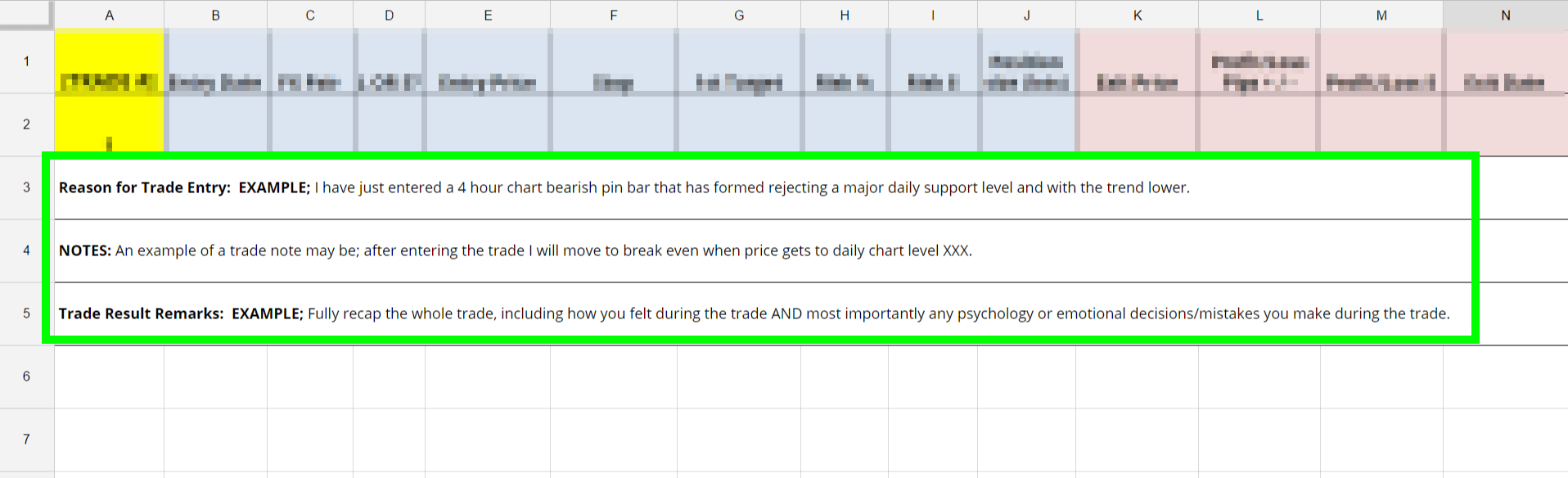
In the trade journal you can download for free at the bottom of this lesson, there are three boxes. 1: Reason for Entry, 2: NOTES: and 3: Trade Results Remarks. The Reason for Entry is where you will do your analysis about the trade. The notes section could include your mindset and decision making progress and anything else you wanted to include.

Lastly, the Trade Results section is the recap of the trade, but also need to include things like how you managed the trade, did you follow your plan? Did not following your plan cost you money? Did you mentally struggle from something or need to work on something which would help? etc.

After writing down your thoughts for many trades you will be able to look back and see how you felt on the very best and worst ones and what the differences were.

You will be able to learn what mindset you were in when you placed the best trades. From this you will be able to work out how you should trade in the future. Should you not trade when feeling a particular way? Should you only trade when you have certain factors met? These are all things you would only be guessing about without having the trade journal to look back on.

Forex trading journal excel spread sheet

Saving Chart Picture

Side Note: The other thing most traders don’t add into their journals is pictures before entry and after exit. Not only will this help when looking back and trying to remember what the actual trade was that you placed, it will help you identify trades you should not have played or how you incorrectly managed a trade.

The really simple, fast and easy way to do this is go into your PC and create a new folder that will store all of these images. I am going to show you this example using MT4 platform.

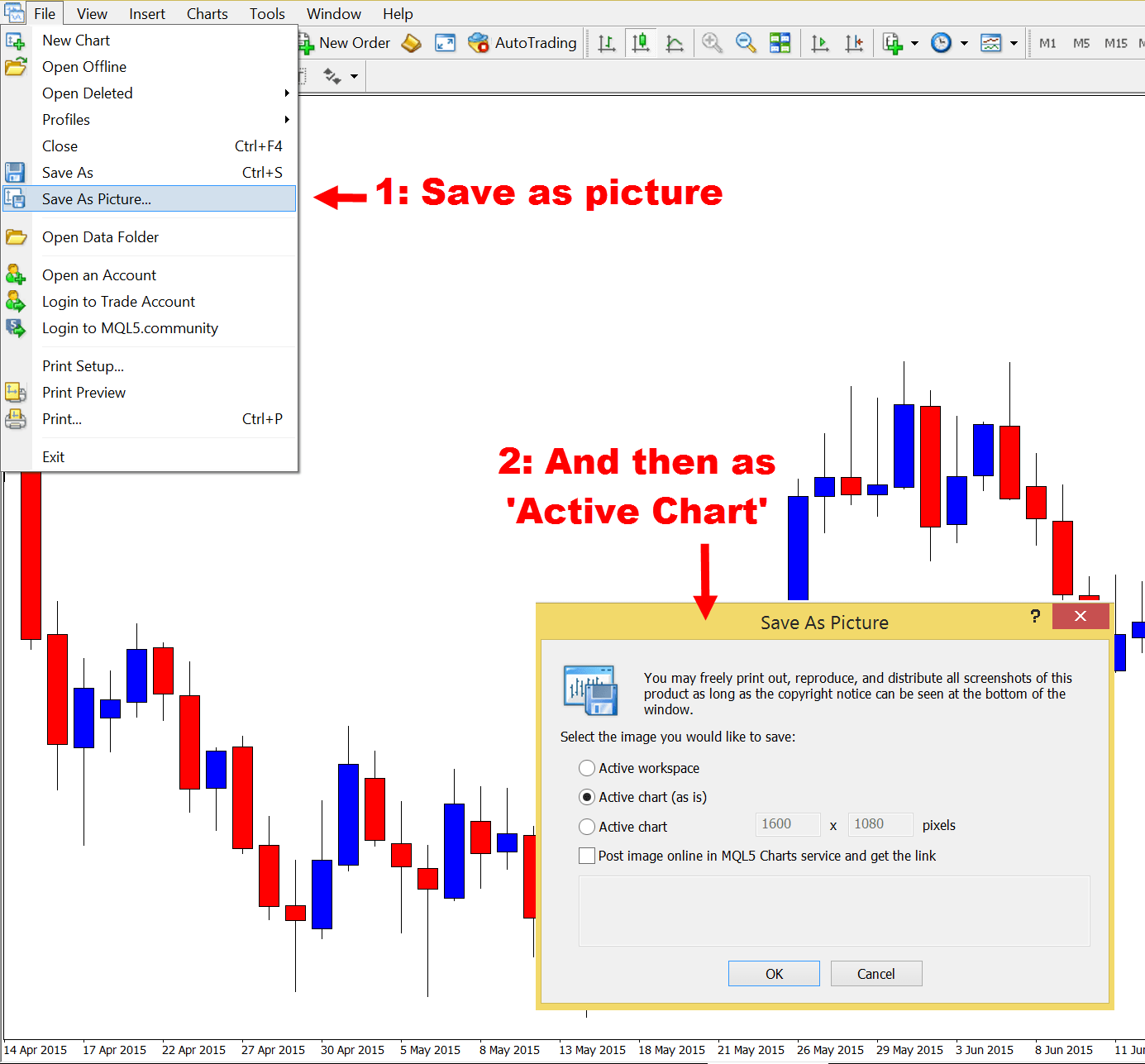
In your MT4, hit the “File” >> “Save As Picture” button which will bring up the chart that you currently have up (so make sure you have the chart you want to save). Make sure to hit the “Active Chart”, but un-select the “Post Image Online in MQL5” box.

Hit the “OKAY” and then when given the option to save, make sure to save into the new folder you have created. TIP: Make sure when saving you add the Pair or market name you are trading but also the date so that when you want to go back and there are 40 EURSUD images, they are very easily separated by date.

Forex MT4 Journal

Build Your Journal into Your Routine

In previous articles we have spoken about just how important it is that you have a trading routine that you follow each day. The best traders in the world are the traders who are consistent and who make the same great decisions time and time again. To create consistency in your trading results you need to have consistency in your routine.

To some traders filing out a journal before and after each trade is a real chore. Some would rather pull teeth than do ‘boring paperwork’, even though it will directly benefit their trading results. A way around this is to incorporate the data input and journal recap into your routine so it becomes part of normal life.

For example, you could make a rule that the last Sunday of every month is the day that you will sit down and go through your trading journal to recap and look for any improvements or errors that are possibly creeping in.

NOTE: Make sure however, you don’t put off the filling out of the trade entry remarks section when you enter the trade. This is important because if you are looking to make a trade, the mindset you are in at that very moment, the thoughts you are having or potential doubts you are feeling are all in that moment.

If you put this off to a later time, for example later than night, then you will be feeling completely different. The trade would have moved and confirmed the doubts and crushed them by becoming a nice winners and all of a sudden your emotions and what you would write is 180 degrees opposite. DON’T PUT THIS OFF – It is designed to help you improve you, your decisions and your trading.

I hope you have enjoyed this article and will start using a trade journal from now on.

You really do only get out what you decide to put in, so set aside some time and start treating your trading like the business it is.

FREE TRADING JOURNAL DOWNLOAD: I have created a FREE trading journal for you that you can download in both Excel spreadsheet format and also a PDF format. This journal does everything we have discussed in this lesson and will not only help you input the basic trade details so that you can track your trades, but also has areas to input information like “Trade Entry Remarks” – “NOTES” and “Trade Exit Recap”.

Download it from your bonus downloads.


Related Forex Trading Articles & Videos

– Daily Routine of Forex & Futures Trader Johnathon Fox


The Best Forex Trading Sessions and Times of Day to Trade

Whilst the foreign exchange market never actually closes because currency is always being exchanged no matter what the day or time, for traders looking to make money from the Forex market, the trading market is open 5 days a week 24 hours a day with the unofficial close each day being at 5PM New York Close time.

Each country has its own trading sessions that fall in-line with their equity markets. New Zealand is the first in the world to open its market followed the Asian session, Europe and UK sessions and lastly the US session. Below is a graph that highlights the different Forex sessions and how the different markets trade. The graph also shows how the UK and US sessions overlap and trade at the same time as each other.


Forex trading sessions


Whilst the market is open for 24 hours there are times within the 24 hours that tend to have higher trade volumes. The Asian session is known to be often very quiet, where as the UK and US sessions have a much higher trade volume. This is super important to traders because there are much better times to make trades than others and obviously traders want to be playing their trades when they have the highest chance of success.

Volatility is at its highest when the volume is at its highest. For traders to make money they need to have high levels of volatility. Volume and volatility are normally at their highest during the London and New York sessions. As mentioned above; for 4 hours both of the UK and US overlap each trading session and are open for trading at the same time.

This period is the usually when the amount of trades being processed is at its peak due to the biggest two regions both being opened for trading.


London Forex trading


Best Hours of the Day to Trade

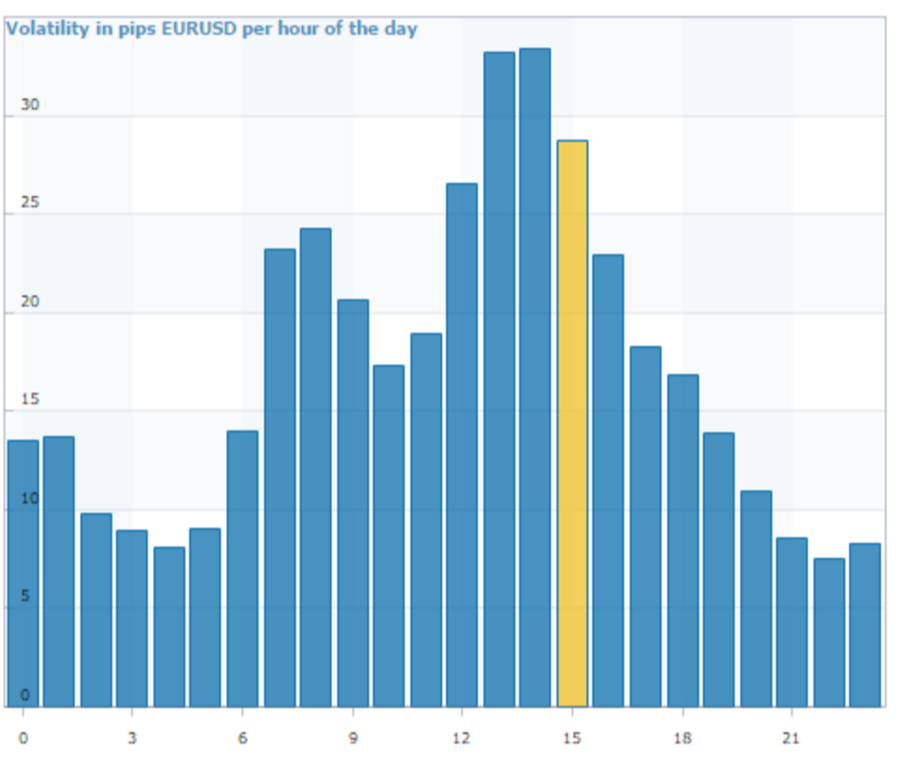
The Forex Market is very appealing to trade and the reason is because it’s open 24 hours per day with the exception of the weekends, but what is the best time to actually trade and earn a big profit? There is not a clear-cut answer to this question because it depends on each currency pair and the region they come from as well as the market conditions, however, during the 7:00 to 8:00 GMT, which is around the London session open and between 13:00 to 14:00 GMT, which is around the New York session open are considered to present the best trading opportunities.

Best time to trade Forex


Looking at the above chart which represents the EUR/USD pip range calculated by hours over the last 50 weeks we can notice that at around 14:00 GMT we have a pick in performance and is the most active trading hour of the day.

When we have a change is sessions from one session to another like from the New York session to the Asia session we get a change in trader sentiment and usually, we get a change in price direction


Best Days of the Week to Trade

Although it’s true that the Forex market is trading around the clock, 5 days per week it doesn’t mean that you should trade every single minute of this time and every single day. Actually, it’s proven that the same like the trading volume is not evenly distributed among all the 4 major sessions the same way the Forex market doesn’t move each day of the week the same, as some days are slower than the others while other days are more active.

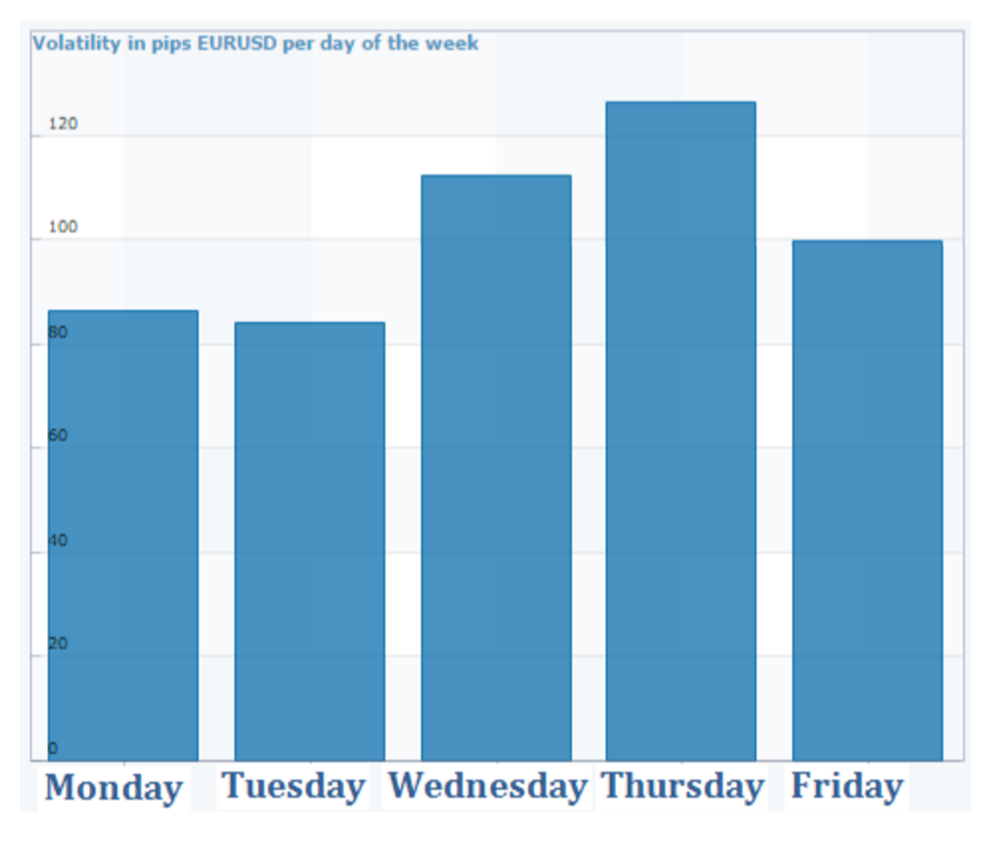
Since not all days of the week are created equally certain days in the week have the tendency to exhibit more movements and usually, Wednesday and Thursday are the most active trading days of the week.

Best days of week to trade Forex

Above is a chart of average pip range for the EUR/USD for each day of the week. It’s recommended to trade more on Wednesdays and Thursdays as it tends to present more trading opportunities.


Best Month of the Year to Trade

Now that we have learned about the intraday and intraweek Forex seasonal patterns, we can look into what are the best months of the year to trade in the currency market.

Each currency pair has its own seasonal pattern that can also be used to predict Forex price trends. A seasonal pattern can be something that can affect any market not just the currency market because it has to do with potentially the economic patterns of the country.

In the stock market, there is something called the January effect it’s when stock performs better between the last day of December and the beginning of January.

In the Forex market, the US Dollar has the tendency to rise during the first months of the year while it tends to bottom during the summer period in August. Other currencies like the Australian Dollar has the tendency to rally from the beginning of April until August when usually it finds a top.

The USD/JPY has a strong seasonal pattern to rally from the beginning of May until August where it finds a bottom. Usually, during October USD/JPY also has the tendency to establish a major swing low.


When Not to Trade

Knowing when not to trade is just as, if not more important than knowing when not to trade and there are some specific times of the day and also week you need to be super careful and mindful of.

When the market opens for the first session of the week the only market open in the world is the New Zealand market for about an hour. This creates incredibly thin order flow where large spikes can happen. You need to also keep in mind that an awful lot could have happened over the weekend and traders could be on edge waiting for the markets to open. A very toxic mix.

You want to be careful and mindful entering trade setups in the last 2 x 4 hour candles of the week. Often these are traders covering up their positions coming into the weekend and you do not want to be caught in their way entering into the market and false moves.

No overtrading

You also want to be careful regarding when you make your first trade of the week. Keep in mind the big guys i,e the traders in the UK and then the US do not open up until long after traders in NZ, Aus, Asia etc, and often especially if making intraday trades, you may want to wait at the start of the week until the big guys have joined in the trading.


Best Time Frames to Trade

Charting platforms generally have many different time frame charts. When we say time frame we mean the time that goes into making an individual candle. These time frames range from 1 min through to 1 month. This means that on a 5 min candle, 5 minutes has gone into making that candle.

Traders that use technical analysis to trade will use these charts to analyse charts to trade. They will normally wait for a candle to close and then assess if it has made a trigger signal that fits their trade criteria.

When new traders come to Forex they invariably start on the smaller time frames such as the 5 min or 10 min candles. The main reason for this is the smaller the time frame, the quicker the candle closes and thus the more trading opportunities the trader can have.

The problem with this is that more trading does not mean more profits and in fact it normally works out the opposite. The smaller time frames are known for noise and confusion. Basically the smaller time frames the more wild and erratic they can be and generally leads to the more over-trading which is a massive account killer.

The best time frames for traders to start their trading on are the higher time frames such as the 4hr and daily charts. The reason for this is the trigger signals produced on these time frames are more reliable. The higher the time frame the more reliable the signals you will find. This is simply because of the extra time that has gone into making the signal.

A candle that has formed on the 1 minute chart has had 1 minutes worth of data gone into making it. A daily candle has 24 hours worth of data gone into making the candle. The more time than has gone into making the candle the more information we can gather.


time frames


When learning to trade, starting with the daily chart trading strategies are not only much better because of better and more reliable signals, but they also give new traders the chance to take their time and make correct decisions. On the smaller time frame charts such as the 5 min chart, trading decisions will be rushed which is never ideal when making or managing trades.

That is not to say that price action cannot be traded on smaller time frames however! Once a trader becomes profitable on higher time frames and they have a consistently profitable method behind them, they can start to work their way down the time frames moving down as far as they want to go.

I go through this process and how a trader should move down the time frames exactly in this lesson at; Trading the Daily Price Action Strategies Down to the Intraday Time Frames


« Previous Page
Next Page »

Primary Sidebar

Forex School Online

High Probability Price Action Trading

How to make, manage and take profit from trades in the markets

Start Learning (It's Free!)

Turn Your Trades into Winners!

The Price action course is the in-depth advanced training on assessing, making and managing high probability price action trades.

Sign up for Free!

Recommended Broker

  • Broker
  • Min Deposit
  • Benefits
  • Score
  • Visit Broker

$200

T&Cs Apply
  • The Lowest Trading Costs
  • 50% Welcome Bonus
  • Award-winning 24 Hour Support
5
Trade Now FreeBets Reviews
Reviews

Footer

Get Our FREE Course, Bonus Strategies & Indicators!
X
Join Us Now!

Your capital is at risk.

X

CORNERSTONE LESSONS

Forex Trading for Beginners

Price Action Trading

How to Trade Forex

Technical Analysis

Forex Charts

Forex Trading Strategies

Money Management 

Compare Brokers

Best Forex Brokers

Forex Demo Accounts

Best Forex Trading Platforms

Forex Apps

Swap Fee Accounts

MT4 Brokers

CATEGORIES

Forex Videos

Trading Lessons

Weekly Trade Ideas

Start Here Guide

ForexSchoolOnline.com helps individual traders learn how to trade the Forex market

WARNING: The content on this site should not be considered investment advice and we are not authorised to provide investment advice. Nothing on this website is an endorsement or recommendation of a particular trading strategy or investment decision. The information on this website is general in nature so you must consider the information in light of your objectives, financial situation and needs.

Investing is speculative. When investing your capital is at risk. This site is not intended for use in jurisdictions in which the trading or investments described are prohibited and should only be used by such persons and in such ways as are legally permitted. Your investment may not qualify for investor protection in your country or state of residence, so please conduct your own due diligence or obtain advice where necessary. This website is free for you to use but we may receive a commission from the companies we feature on this site.

We Introduce people to the world of currency trading. and provide educational content to help them learn how to become profitable traders. we're also a community of traders that support each other on our daily trading journey

Forexschoolonline.com is not a financial advisor. Do your research before investing your funds in any financial asset or presented product or event. We are not responsible for your investing results.

Copyright © Forex School Online Sitemap  - Privacy Policy - Disclaimers & Terms of Use - CONTACT US